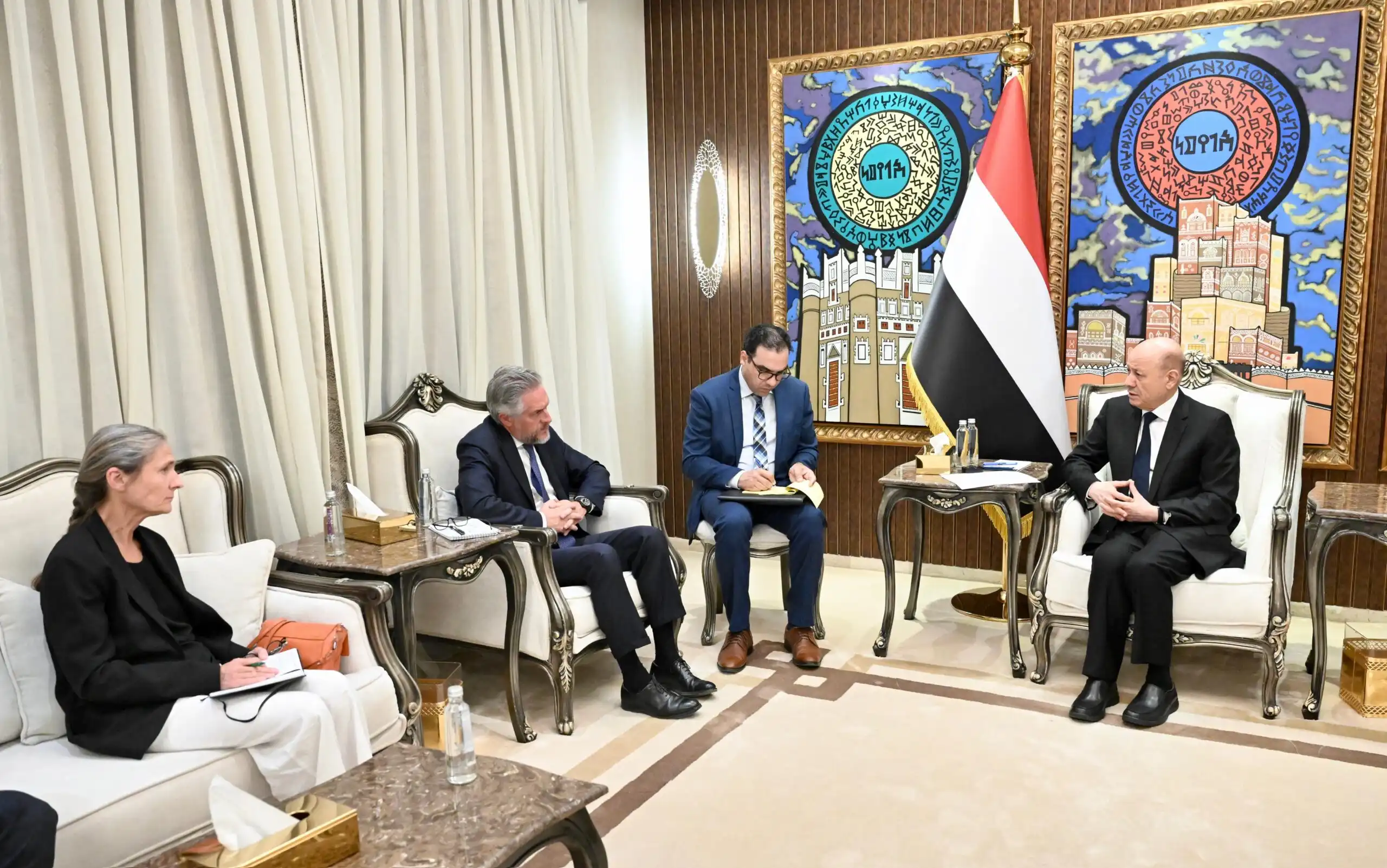
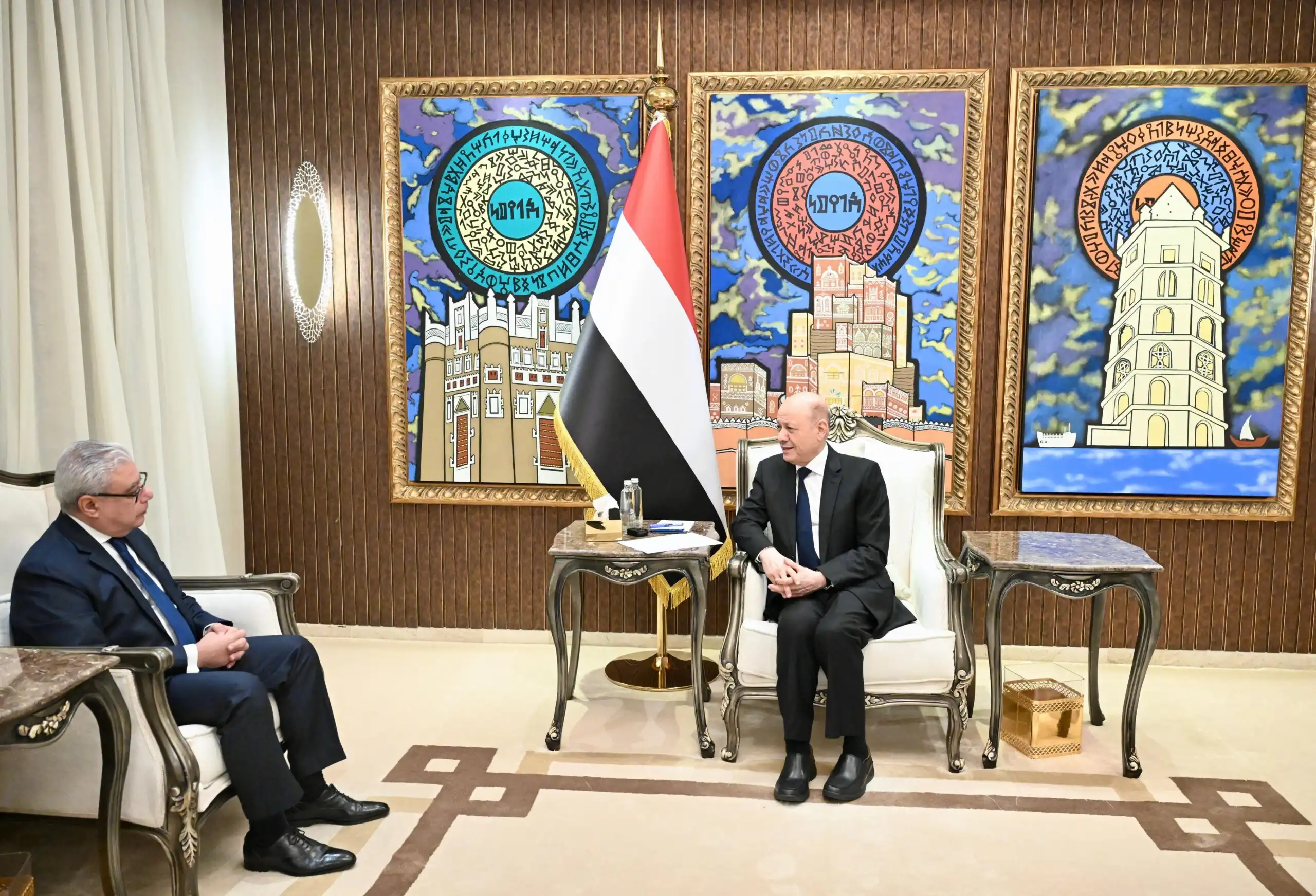
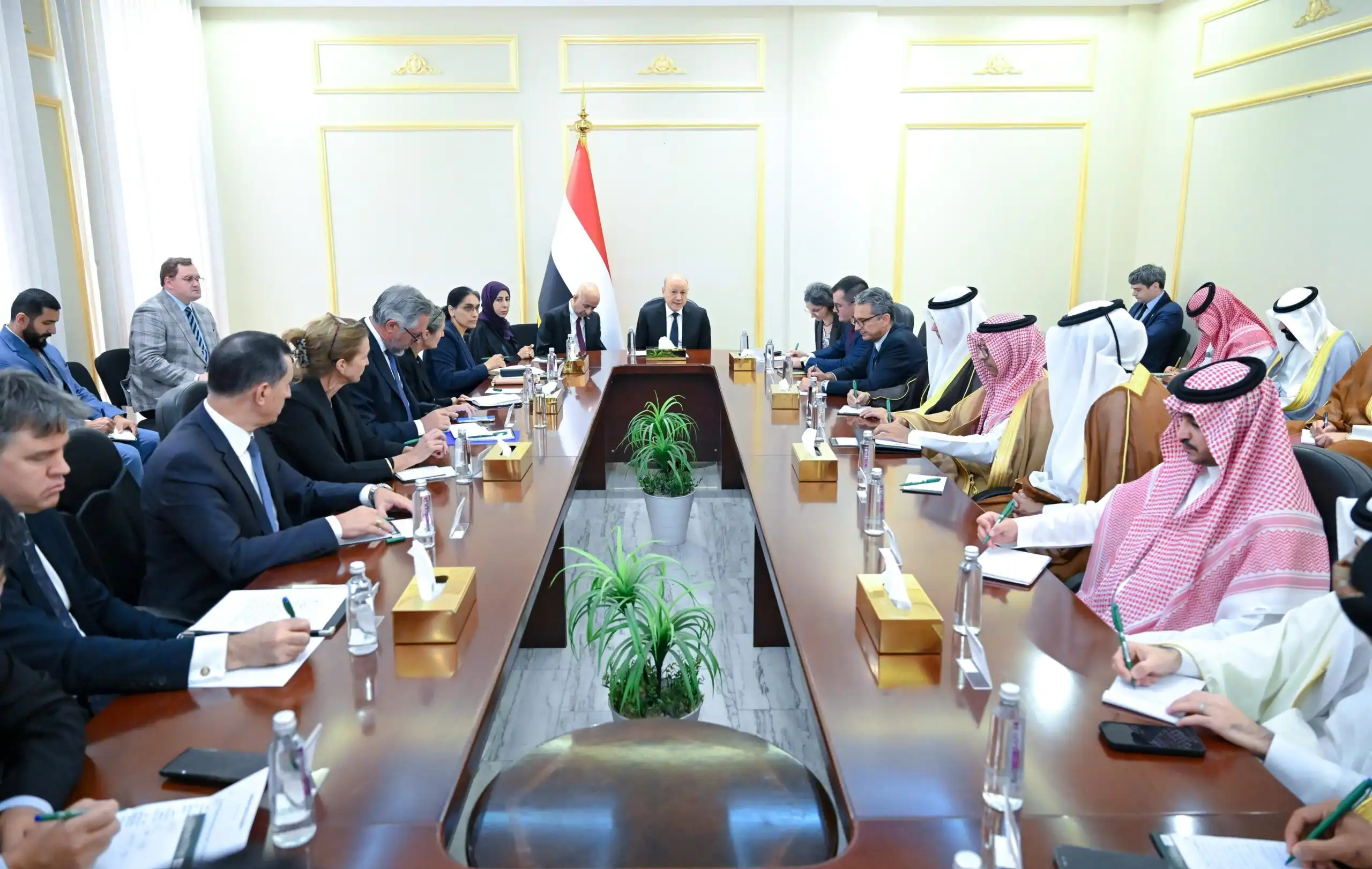
The National Defense Council affirms the state’s ability to regain initiative and prevent the Yemeni coast from being a platform for global extortion.

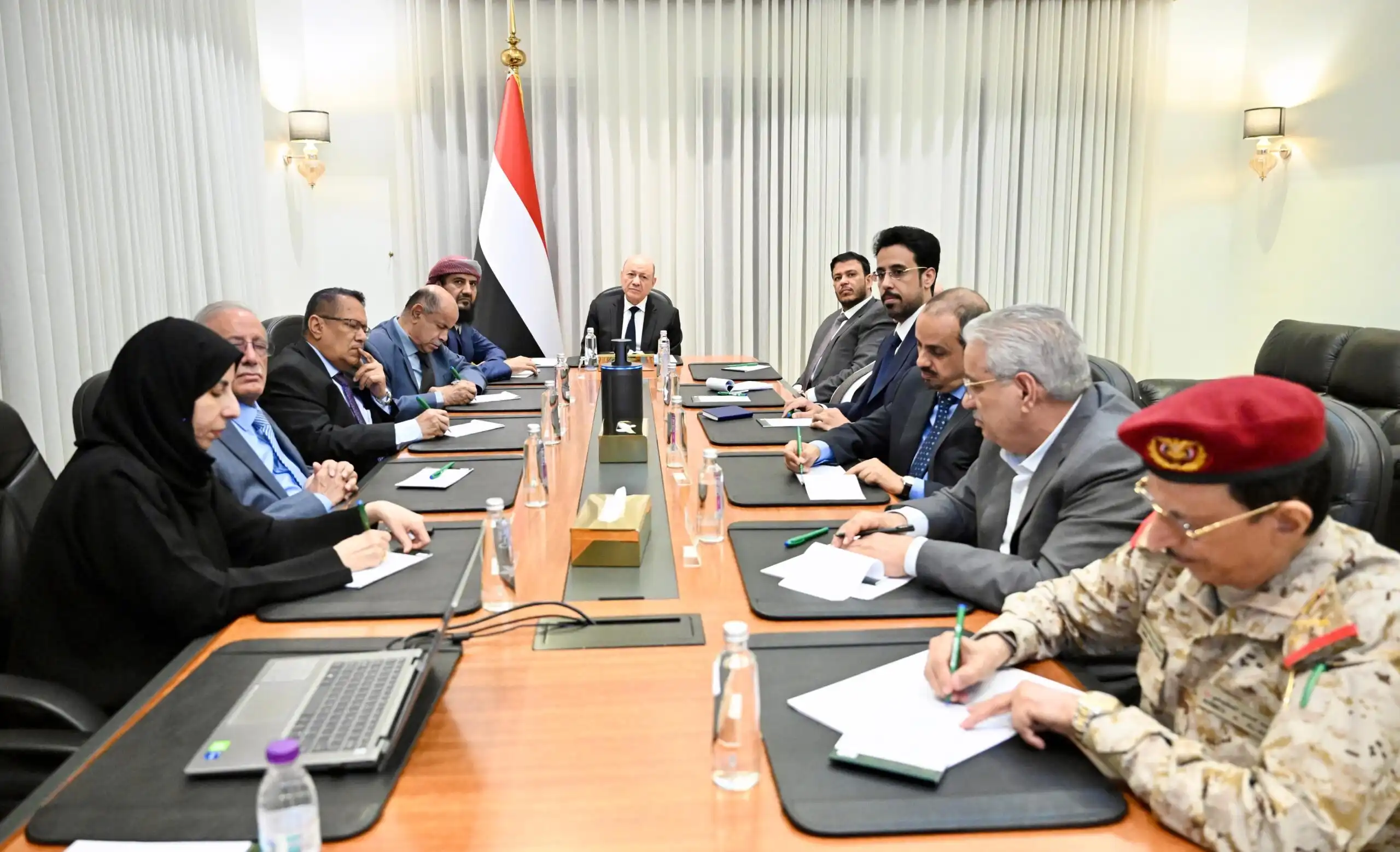
- President Alimi chaired a National Defense Council meeting to discuss military developments.
- The council reviewed military reports on combat readiness in key operational areas.
- The National Defense Council praised armed forces for their victories against Houthi militias.
- The council emphasized commitment to national sovereignty and preventing external threats.
President Alimi Leads National Defense Council Meeting
On Thursday, President Dr. Rashad Mohammed Alimi, the Chairman of the Presidential Leadership Council and Supreme Commander of the Armed Forces, chaired a meeting of the National Defense Council. The meeting included members of the council: Sultan Al-Arada, Abdulrahman Al-Mahrami, Dr. Abdullah Alimi, Othman Majali, Mahmoud Al-Sabihi, and Salem Al-Khanbashi. Council member Tariq Saleh was absent with an excuse.
Discussion on Military Developments
The meeting, attended by Speaker of the House Sheikh Sultan Al-Barakani, Prime Minister Dr. Sha’if Al-Zandani, Chairman of the Shura Council Dr. Ahmed Obeid Bin Dagher, Chairman of the Consultation and Reconciliation Commission Mohammed Al-Ghaithi, and other relevant ministers and officials, focused on military developments across various operational theaters. The discussions addressed the recent terrorist escalation by Houthi militias and its implications for national security, regional stability, and the security of maritime routes.
Reports on Combat Readiness
The council reviewed military and security reports regarding operations in the fronts of Taiz, Marib, Al-Jawf, Al-Bayda, and Al-Dhale, among other areas. They assessed the combat readiness of forces and the measures taken to regain the initiative in several fronts.
Acknowledgment of Armed Forces
The National Defense Council praised the heroes of the armed forces and security, along with all military formations, for their significant victories and achievements in the fronts of Marib, Al-Jawf, and Al-Bayda. The council commended their bravery and resilience in thwarting militia plans and inflicting heavy losses on them.
Recent Developments in the Western Coast
The council addressed recent developments in the western coast of Taiz Governorate, including the repositioning of forces in the area. They emphasized that any temporary military advance would not grant the militias the right to impose a fait accompli by force. They reiterated that this battle is not about a single location or front but a comprehensive national struggle to restore state institutions and assert sovereignty over all national territory. Any attempt by the militias to convert a temporary military gain into a permanent political or geographical reality is merely an illusion that the will of the Yemeni people and the valor of their armed forces will dispel.
Commitment to National Sovereignty
The National Defense Council stressed that the comprehensive battle to restore state institutions cannot leave any part of the Republic outside its sovereignty. It will not allow any portion of Yemeni land, coasts, or islands to become a platform for threatening Yemen, its neighbors, or international navigation. The council affirmed that the state will continue its constitutional and national responsibilities until the coup is ended and the threats to Yemen, the region, and the world are eliminated.
Deterrence Operations
In this context, the council confirmed that the deterrence operations initiated by the armed forces will not be limited to a specific front or area. They will respond decisively to threats and militia movements across various operational theaters, following military assessments, rules of engagement, and international humanitarian law.
Call for Civilian Compliance
The council urged citizens in operational areas to fully comply with the instructions and guidelines issued by the armed forces and relevant authorities. They advised civilians to avoid militia sites, movements, gatherings, and weapon caches to ensure their safety and facilitate the armed forces’ tasks in protecting civilians and addressing threats.
Yemen’s Defense of Maritime Security
The council asserted that Yemen, while defending Bab Al-Mandab, its coasts, islands, and territorial waters, is not only defending itself but also standing on the front lines for the freedom of navigation, maritime security, and the stability of global trade. It protects the interests of countries and peoples that extend beyond Yemen and the region.
International Community’s Responsibility
The National Defense Council called on the international community, particularly the Security Council, permanent member states, Red Sea coastal countries, and international partners, to fulfill their responsibilities. They urged these entities not to allow Bab Al-Mandab and Yemeni coasts and islands to become tools for extortion or platforms for threatening navigation and international trade. The council emphasized that Yemen does not ask the world to fight its war but seeks the implementation of international legitimacy decisions and support for its government in protecting its territory, sovereignty, territorial waters, and national institutions.
Accountability for Houthi Actions
The council held the Houthi militias fully responsible for the consequences of their terrorist escalation, including severe human rights violations, targeting residential areas, public roads, and civilian facilities with shelling, sniping, and drone attacks, leading to the displacement of thousands of civilians. They affirmed that the militias initiated this war and must bear the consequences of this choice.
Condemnation of Attacks on Saudi Arabia
The National Defense Council strongly condemned the renewed attacks by Houthi militias on the territory of the sisterly Kingdom of Saudi Arabia. They reiterated the Republic of Yemen’s full solidarity with the Kingdom and its legitimate right to protect its security, citizens, and national resources.
Interconnected Security of Yemen and Saudi Arabia
The council stated that using Yemeni territory to launch attacks on the Kingdom also represents an aggression against the interests of the Yemeni people. They emphasized that the security of Yemen and the Kingdom is interconnected. The strategic partnership between the two countries, along with Saudi Arabia’s support for the Yemeni state and people, as well as for economic, humanitarian, and developmental stability, makes the protection of this relationship and the interests of both peoples an integral part of the Yemeni state’s responsibility.
Support for Armed Forces and Civil Initiatives
The council praised the widespread popular support for the armed forces, as well as community, tribal, and humanitarian initiatives to support fighters, assist displaced persons, and care for the families of martyrs and the wounded. They valued the responsible positions of political and social forces, intellectual and awareness platforms, media, and national elites that contributed to enhancing trust in the state and its armed forces and unifying the internal front.
Call to Tribal Members
The council renewed its call to tribal members and those misled in areas controlled by the militias to refrain from involving their children in a war that does not serve the interests of Yemenis. They urged them to protect their youth from becoming fuel for a cross-border armed project. The council called on those still within the ranks of the militias to return to the right path and align with their people and state.
Tribute to Martyrs and Support for Families
The council expressed condolences for the souls of the martyrs from the armed forces, security, and all military formations, as well as civilians who fell victim to Houthi attacks. They wished a speedy recovery for the wounded and directed the government and relevant authorities to continue caring for the families of martyrs and fulfill their rights. They also called for providing the best treatment and care for the wounded and intensifying humanitarian and relief interventions to shelter and assist displaced and affected families, considering this a constitutional and moral duty that cannot be delayed or neglected.
To follow the news in Arabic