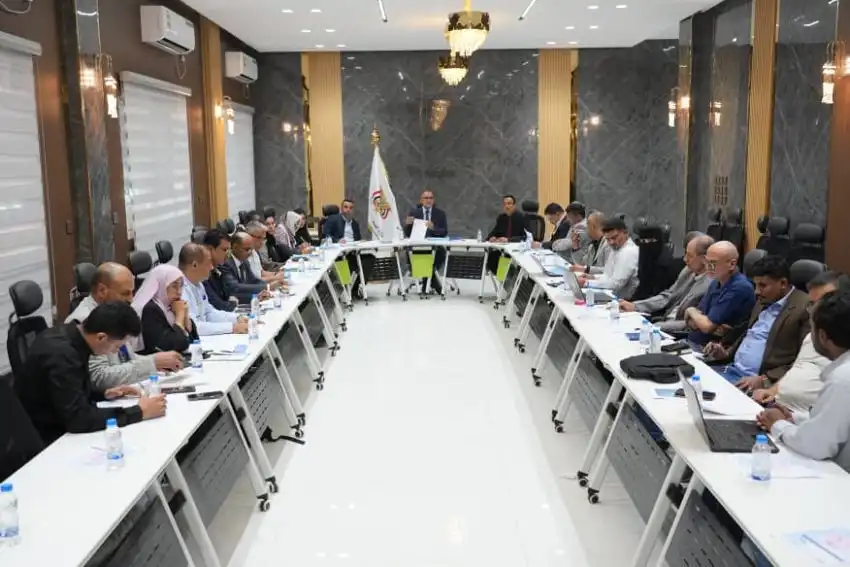
A legal seminar in Marib calls for urgent international action to break the siege of Taiz and classify Houthi militias as a terrorist group.


- Demands for Terrorist Designation The seminar demanded that the United Nations Security Council and European Union countries quickly classify the Houthi militias as a terrorist group.
- It called for a coordinated effort between official and community initiatives to break the siege on Taiz and support the "Dawn of Yemen" campaign until its declared objectives are achieved.
- The first topic addressed the siege from the perspective of Islamic law, emphasizing the obligation to support the besieged and end the siege.
- The third topic presented statistics on the violations and humanitarian crimes that the seminar claimed the Houthi militias commit against the people of Taiz.
Human Rights Seminar in Marib Calls for International Action to Lift Taiz Siege
A human rights seminar held today in Marib confirmed that the suffocating siege imposed by the Iran-backed Houthi militias on the city of Taiz constitutes a complete war crime, both materially and morally. The seminar highlighted the use of the siege as a means to starve the population and deprive them of water and essential services, alongside the deliberate targeting of residential neighborhoods, hospitals, and civilian facilities.
International Community Urged to Act
The seminar, organized by the Communication Program with Yemeni Scholars under the title “The Taiz Siege: A Houthi Crime and a Duty to Support,” called on the international community, the United Nations, and human rights and humanitarian organizations to fulfill their legal and moral responsibilities. Participants urged immediate and effective action to stop violations against besieged civilians, including urgent steps to break the siege and open safe corridors for the delivery of water, food, medicine, shelter materials, and other humanitarian aid.
Demands for Terrorist Designation
The seminar demanded that the United Nations Security Council and European Union countries quickly classify the Houthi militias as a terrorist group. It also called for the referral of files related to violations and crimes attributed to them to the International Criminal Court in The Hague, ensuring accountability for the involved leaders and individuals, preventing them from escaping punishment.
Support for Taiz Residents’ Rights
Participants emphasized that supporting the people of Taiz in their legitimate right to defend themselves, their homes, properties, and dignity against what they described as the terrorist hordes of the Houthi militias represents a legal, moral, and ethical duty. This obligation extends to individuals, entities, and official and community institutions, each according to their capacity and through lawful means.
Importance of National Unity
The seminar stressed the importance of enhancing national unity, both officially and among the public, behind the political leadership represented by the Presidential Leadership Council, the armed forces, and popular resistance. It called for a coordinated effort between official and community initiatives to break the siege on Taiz and support the “Dawn of Yemen” campaign until its declared objectives are achieved. These objectives include ending the suffering of Yemenis, restoring state institutions, liberating the capital Sana’a, and other territories controlled by the Houthi militias, while establishing the authority of the state, law, and order, and achieving peace.
Discussion of Key Issues
The seminar discussed working papers divided into three main topics. The first topic addressed the siege from the perspective of Islamic law, emphasizing the obligation to support the besieged and end the siege. It highlighted the responsibility of scholars, preachers, and official and community institutions to clarify the legal ruling on the siege and its effects, raise community awareness about their duties towards the besieged, and enhance solidarity with the people of Taiz.
The second topic examined the siege from the perspective of international humanitarian law, focusing on the legal rules governing the protection of civilians during armed conflicts. It underscored the guarantees established by the Geneva Conventions and related rules to protect populations and civilian objects, as well as the prohibition of starving civilians and using starvation as a method of warfare.
The third topic presented statistics on the violations and humanitarian crimes that the seminar claimed the Houthi militias commit against the people of Taiz. It detailed the suffering of the population since 2015 due to the siege, restrictions on roads and supplies, civilian movement, and access to humanitarian aid, along with the resulting humanitarian and living consequences documented by various human rights and humanitarian reports.
To follow the news in Arabic