How the Houthi militia built a parallel economy funding its war with $2.5 billion annually.

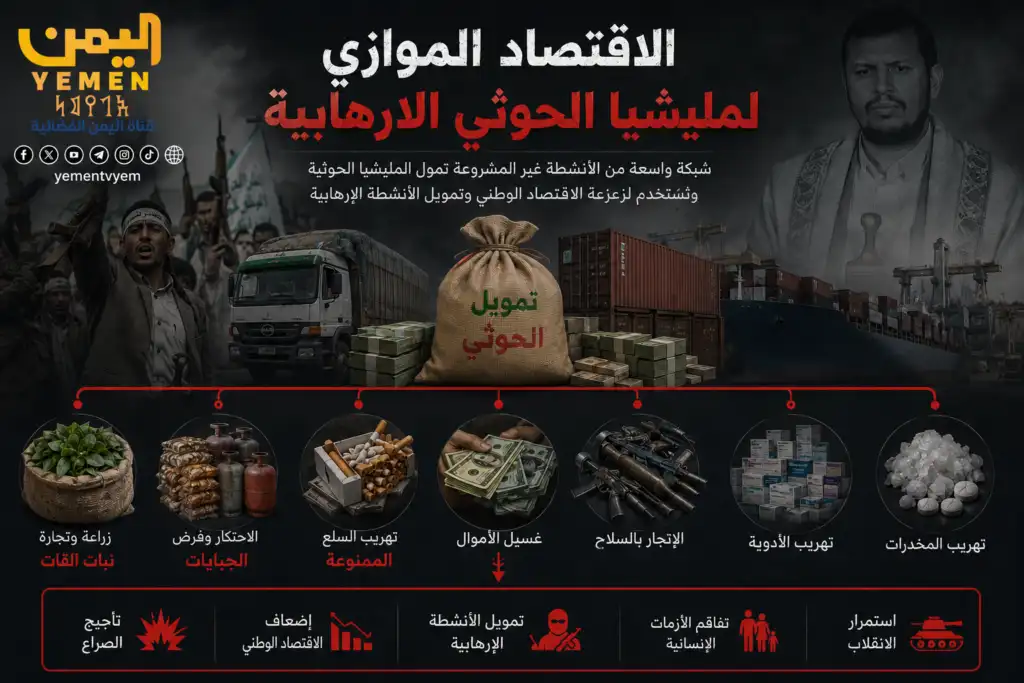
Houthi Militia Establishes Parallel Economy to Fund War
A recent study from the Al-Mokha Center for Studies reveals that since seizing control of Yemen’s capital, Sana’a, in 2014, the Houthi militia has not only taken over state institutions and resources but has also restructured the economy in areas under its control. This transformation has led to the establishment of a parallel economy aimed at supporting the militia’s political and military agenda, providing sustainable funding without oversight or accountability.
Study Methodology: Analyzing the Private Sector Structure
The study analyzed 68,000 commercial records and licenses, offering a clear understanding of the changes in the private sector over the past decade under Houthi control. The data indicates several significant adjustments, including:
- The dismantling of traditional trading houses that once formed the backbone of Yemen’s economy.
- The empowerment of new trade networks linked to Houthi leaders through special privileges and facilitation.
- The redistribution of economic activity to align with a war economy.
Tools of Control: From Taxation to Monopoly
The study highlights that the Houthis have created a comprehensive economic system based on:
- Complete control over commercial licensing.
- Imposing illegal taxes, customs duties, and fees.
- Establishing collection networks that include improvement fees, zakat, internal customs, and seasonal levies.
The private sector has become a primary source of funding for the Houthi militia, especially in lucrative sectors such as oil, energy, and currency exchange.
Control Over Supply Chains: Import Trade Under Houthi Dominance
The study indicates that 26% of new commercial registrations pertain to general trade and import sectors, reflecting the Houthis’ strategy to:
- Control the movement of goods.
- Dominate land and sea ports.
- Impose double fees on shipping and transportation.
- Monopolize the import of essential goods through companies linked to Houthi leaders.
This control has enabled the militia to influence prices and create monopolistic networks that yield substantial profits.
Annual Revenues: A War Economy Valued at $2.5 Billion
The study estimates that the Houthi militia generates approximately 1.5 trillion Yemeni riyals (around $2.5 billion) annually from the private sector. These revenues include:
- Taxes and customs duties.
- Fees and levies.
- Indirect revenues resulting from rising prices and transportation costs.
These figures indicate that the Houthis manage a parallel economy larger than the budgets of small nations, using it to finance their war efforts and expand military influence.
Serious Implications for Yemen’s Economic Future
The study warns that the continuation of this parallel economy will lead to:
- Weakened future state capacity to restore its financial institutions.
- Complicated political settlements, as beneficiaries of the war economy resist change.
- Ongoing price increases and a decline in citizens’ living standards.
- The expansion of the shadow economy at the expense of the formal economy.
In conclusion, the report suggests that the Houthi economy has evolved into a comprehensive system that funds the war, reshapes the private sector, and creates a new economic class linked to the militia. This parallel economy poses one of the most significant challenges for the Yemeni state moving forward.
For more information, visit Yemen TV.
To follow the news in Arabic