The Ministry of Interior announces the arrest of Houthi terrorist cells in Aden, Lahij, and Abyan.

- The Ministry of Interior arrested Houthi terrorist cells in Aden, Lahij, and Abyan.
- The cells planned attacks on security and military leaders in the temporary capital.
- Minister Haidan emphasized commitment to internal security as part of "Dawn of Yemen" operation.
- Houthi militias exploit communication networks for surveillance and terrorist operations.
Interior Ministry Announces Arrest of Houthi Terrorist Cells in Aden, Lahij, and Abyan
The Ministry of Interior announced the arrest of several terrorist cells affiliated with the Iranian-backed Houthi militias during September. These cells planned to incite chaos and carry out operations targeting security and military leaders in the temporary capital of Aden and the Lahij and Abyan governorates, as well as military reinforcements and logistical supply lines.
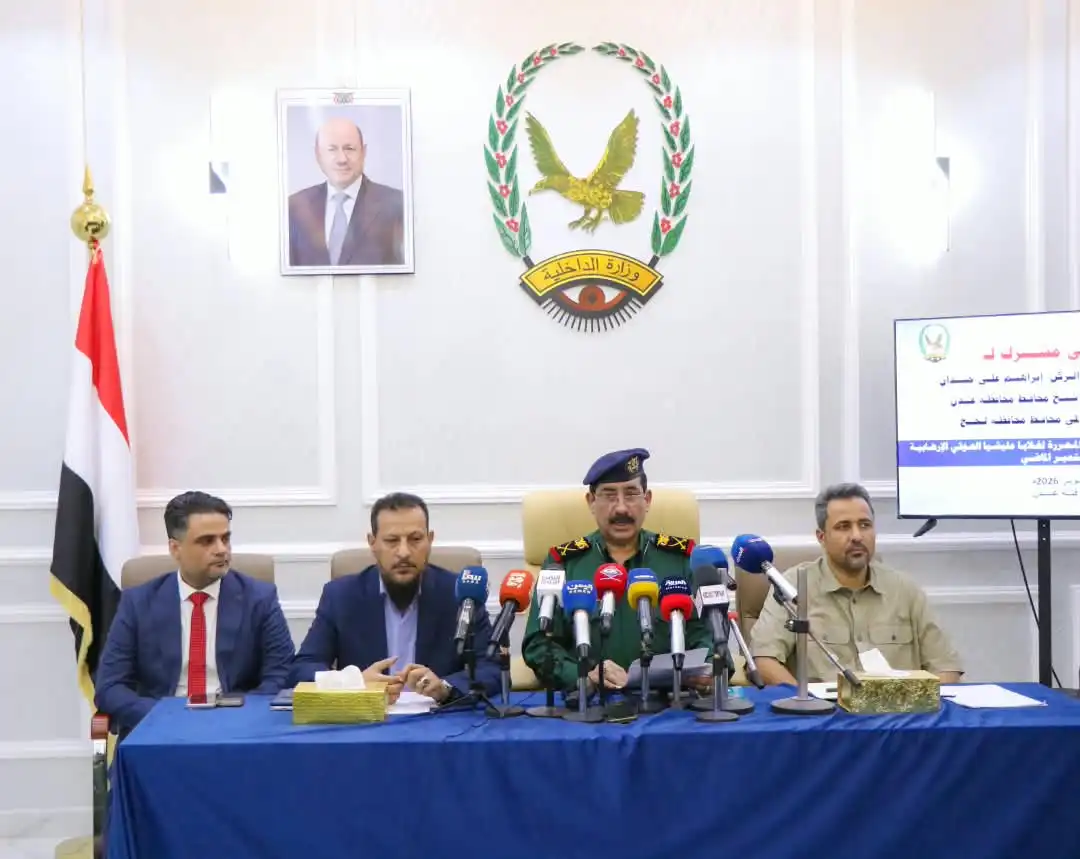
This announcement came during a joint press conference held today in Aden, featuring Interior Minister Major General Ibrahim Haidan, State Minister and Aden Governor Abdulrahman Sheikh, Lahij Governor Murad Al-Halimi, and Deputy Minister of Information Salah Al-Aqel.
Commitment to Internal Security
Minister Haidan emphasized that protecting the internal front is an integral part of the “Dawn of Yemen” operation, which the people of Yemen hold great hopes for in restoring state institutions and liberating every inch of their homeland.
He stated, “The security forces are engaged in a continuous battle against the terrorist plots of the Iranian-backed Houthi militias to enhance security and stability.” He affirmed that the victories achieved by all security units in securing the internal front represent a fundamental pillar and a true starting point toward completing the liberation battle and achieving the long-awaited victory that our people have eagerly anticipated for over a decade.
Houthi Militias’ Terrorist Tactics
Haidan added, “We are fighting against the Houthi terrorist militias, which have made terrorism a doctrinal methodology, deviating from the teachings of our noble Islamic religion. Their terrorism has not only targeted the interior and communities in liberated governorates but has also reached sacred Islamic sites, such as Mecca and Medina, which are the holiest places for Muslims and the hearts of over a billion Muslims worldwide.”
He pointed out that the Houthi militias have abandoned all norms, traditions, and authentic societal values, employing despicable methods, including the recruitment of children, women, African migrants, and the elderly to achieve their extremist and terrorist goals, thereby undermining security and public tranquility in the liberated governorates.
Exploitation of Communication Networks
The Interior Minister highlighted that the Houthi militias exploit their control over the telecommunications and internet sectors to execute their terrorist plans. They utilize these resources for surveillance, monitoring, and information gathering to support their destructive activities and terrorist operations.
He confirmed that this terrorist methodology aligns with the Iranian regime’s approach, noting that everything the Houthi militias have achieved today bears the fingerprints of Iranian Revolutionary Guard and Hezbollah experts. This includes recruitment methods, training, and manufacturing of explosives, improvised explosive devices, and various types of weapons in their possession.
Recent Arrests and Investigations
The Interior Minister reviewed the results of investigations with Houthi cell members, revealing that they received training on executing terrorist plans, planting explosives, and conducting infiltration operations from experts in the Revolutionary Guard and Hezbollah in several Houthi-controlled governorates. Specialized training courses for these cell members occur in Saada, supervised by advanced Iranian experts in terrorist operations.
He mentioned that the latest arrested cell, at the end of last month, consisted of a highly complex Houthi network comprising 18 terrorist elements, directly overseen by the terrorist Amjad Khaled Farhan and the Houthi-appointed Lahij Governor Ahmad Jareeb. This cell underwent training in multiple Houthi-controlled governorates, with some training periods lasting up to five months.
Foiled Terrorist Plans
Haidan noted that the militias had invested significant resources in this network, harboring high hopes for executing their terrorist plans in Aden, Lahij, and Abyan. However, these plans failed, and the network met the same fate as previous terrorist cells.
He asserted that despite the unlimited support the Houthi militias provide to these cells and the direct supervision by Revolutionary Guard and Hezbollah experts, the readiness, vigilance, and bravery of the Interior Ministry’s heroes, in collaboration with their intelligence counterparts, contributed to the successive dismantling of these cells and delivering painful blows to them in recent months. These actions thwarted the militias’ bets on these cells to incite chaos, destabilize security, and disrupt conditions on the battlefronts in the liberated governorates, particularly in Aden, Lahij, and Abyan, while preparing the ground for their control over the cities.
Call for Unity and Vigilance
Minister Haidan urged everyone to enhance cooperation and maintain the highest levels of vigilance, awareness, and responsibility to achieve further security successes, thwart militia plans, and close any internal gaps they might exploit to incite chaos and carry out terrorist acts in the liberated governorates. He praised the efforts of security forces in various fields and locations to protect citizens’ security and national gains.
He also appreciated the generous and ongoing support from the brothers in the Kingdom of Saudi Arabia in all fields, particularly in security, which has significantly contributed to achieving these security successes.
Response to Displacement Crisis
In his remarks, the State Minister and Aden Governor outlined the security measures taken to address the wave of displacement caused by the Houthi militias’ escalation in the Al-Hudaydah and Taiz governorates. He noted that these measures included prohibiting the entry of armed individuals. The local authority also responded to humanitarian needs by establishing camps for displaced persons on the outskirts of the governorate in coordination with the local authority in Lahij and relevant government agencies.
He added, “The number of established camps reached 800 tents, equipped with various facilities and public services, accommodating approximately seven thousand displaced individuals within half a month.” He commended the efforts of security forces and the level of coordination and cooperation among them to secure the governorate and thwart any Houthi attempts to incite chaos and destabilize security.
Coordination Efforts in Lahij
The Lahij Governor highlighted that the coordination efforts between security agencies in the governorates and the Ministry of Interior contributed to the arrest of these cells and the thwarting of the terrorist and sabotage actions they intended to execute. He called on everyone to feel a sense of responsibility and work diligently to serve the security of the liberated governorates and prevent their fall into the Houthi militias’ plans.
Achievements Against Houthi Terrorism
Meanwhile, the Deputy Minister of Interior, Major General Muhammad Musaad Al-Amir, reviewed some of the security achievements in confronting Houthi terrorism supported by the Iranian regime, which targeted the temporary capital of Aden and the Lahij and Abyan governorates.
He confirmed that despite the resources, plans, and methods employed by the Houthi militias to execute their terrorist schemes, the security forces managed to achieve significant and qualitative successes, thwarting many terrorist operations before they could be executed and dismantling networks of Houthi terrorists that had received specialized training from experts in the Revolutionary Guard and Hezbollah.
He mentioned that in Aden, security forces in the Dar Saad district arrested a member of this terrorist cell, identified as Walid Saleh Ahmed Saleh, caught in the act with explosives and materials related to the terrorist plot. He added, “Investigations led to the discovery of other explosives and targets that the cell planned to attack within the temporary capital of Aden.”
He stated, “The cell had received training in Al-Hubban in Taiz governorate and was linked to several Houthi terrorist leaders, including Mamoun Al-Zajir and Muhammad Al-Khasha. Their plans included targeting security and military leaders and vital facilities in the temporary capital of Aden, in addition to recruiting individuals to carry out terrorist operations and incite divisions, destabilizing internal security, and writing slogans against the legitimacy-supporting coalition to stir unrest and chaos.”
Recent Arrests in Lahij
In Lahij, the Deputy Minister of Interior noted that security forces achieved significant security successes against Houthi militia cells, successfully arresting and dismantling one of the most dangerous Houthi terrorist networks aimed at destabilizing internal security in the governorate and its neighboring areas at the end of last month, consisting of 18 terrorist elements.
He pointed out that this network was led by Houthi leader Amjad Khaled Farhan, who directly commanded it, along with Houthi leader Ahmad Jareeb, appointed by the Houthi militia as the governor of Lahij, who provided political and logistical cover, transportation vehicles, and facilitated the movements of its elements. Additionally, Houthi leader Ali Obeid Thabit Al-Azibi played a crucial role in the logistical and financial support for the cell’s elements, while terrorist Wajdi Al-Haidari managed the training of these elements in several Houthi-controlled governorates. The field command of this network was led by terrorist Hamdi Yasser Saleh, known as Abu Ayat.
He added, “This cell underwent numerous training courses starting in Saada, then in Dhammar, and finally in Al-Hubban in Taiz, with intensive training at a very high level in various fields, supervised by experts working for the militia.”
He noted that this cell passed through multiple levels and stages in the terrorist training process, with each course lasting between 45 days to five months. The Houthi militias placed significant bets on this cell to execute their terrorist plans, but the heroes of the security and intelligence forces were quicker to apprehend them before they could carry out their schemes.
Cell Structure and Objectives
According to the Deputy Minister of Interior, the cell was divided into two groups. The first group focused on surveillance and monitoring, tasked with observing security and military leaders in the temporary capital of Aden and Lahij, as well as monitoring military convoys reinforcing the battlefronts (Bab Al-Mandab and Al-Sabiah along the routes connecting Lahij to the frontlines).
The second group was responsible for planting explosives and targeting security and military leaders in the temporary capital of Aden and Lahij by placing improvised explosive devices along their routes and near their workplaces and residences, in addition to targeting military reinforcements and logistical supply lines.
Women’s Cell Arrested
The Deputy Minister of Interior revealed that security forces in Lahij arrested a women’s cell linked to the Houthi terrorist militias on September 22, 2026. This cell was tasked with conducting surveillance, tracking, recruitment, and executing sabotage actions targeting security and stability in the governorate.
He noted that security forces in Abyan successfully apprehended a Houthi terrorist cell in the Lawdar district at the beginning of last month, on September 1, 2026, following precise monitoring and tracking operations conducted by the security forces in the governorate.
He stated, “The Houthi terrorist cell, consisting of two individuals, planned to execute terrorist and sabotage operations aimed at destabilizing security and stability in the governorate and targeting security and military forces and civilians.”
He confirmed that security forces in the liberated governorates remain vigilant and highly prepared to confront Houthi cells and their terrorist plans. He assured that those involved would not escape punishment, and once the investigation and evidence collection procedures are completed, they would be referred to the relevant judicial authorities to receive their just punishment according to the law.
To follow the news in Arabic