The Minister of Industry and Trade emphasizes the crucial role of legal accountants in combating money laundering and terrorism financing.

- Minister Emphasizes Role of Accountants in Combating Money Laundering and Terrorism Financing Dr.
- He stressed the need to establish principles of integrity and transparency to protect the national economy from illicit financial practices, thereby boosting confidence in the business and investment environment.
- He affirmed that certified accountants play a crucial role in examining financial records, verifying transaction integrity, and identifying suspicious activities.
- He emphasized the necessity for firms to verify the identities of clients and beneficial owners, assess risks, report suspicious transactions, and maintain records in accordance with applicable legislation.
Minister Emphasizes Role of Accountants in Combating Money Laundering and Terrorism Financing
Dr. Mohammed Al-Ashwal, the Minister of Industry and Trade, highlighted the importance of enhancing the role of certified accountants and auditing firms in the fight against money laundering and terrorism financing. He stressed the need to establish principles of integrity and transparency to protect the national economy from illicit financial practices, thereby boosting confidence in the business and investment environment.
Workshop on Accountants’ Role in Anti-Money Laundering
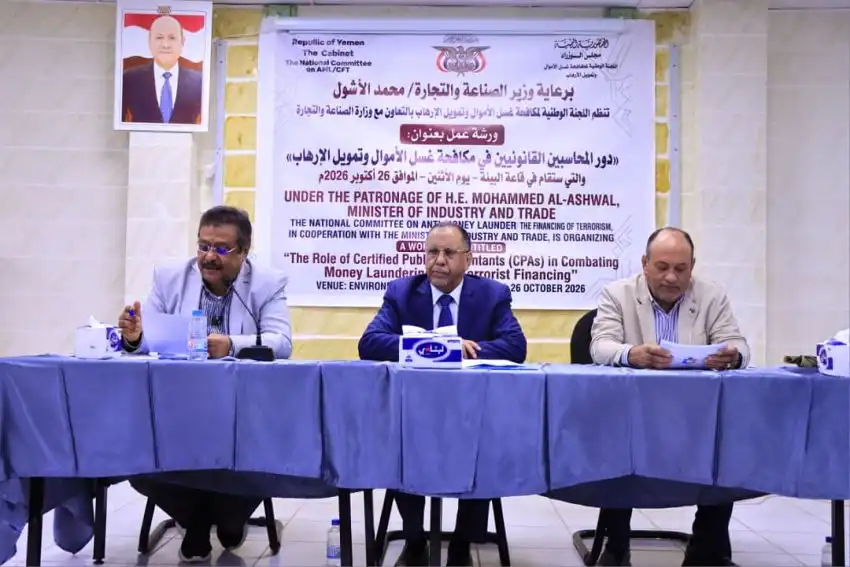
This statement came during his speech at the opening of a workshop titled “The Role of Certified Accountants in Combating Money Laundering and Terrorism Financing.” The workshop, organized by the National Committee for Combating Money Laundering and Terrorism Financing in coordination with the Ministry of Industry and Trade, took place in the temporary capital, Aden. Approximately 60 certified accountants attended the event, which also featured the presence of Deputy Minister of Industry and Trade Salem Salman Al-Wali, along with other officials and specialists.
Shared Responsibility in Combating Financial Crimes
Al-Ashwal pointed out that combating money laundering and terrorism financing represents a shared national responsibility that requires the integration of efforts from both the public and private sectors. He affirmed that certified accountants play a crucial role in examining financial records, verifying transaction integrity, and identifying suspicious activities. He noted that the ministry has issued guidelines for combating money laundering and terrorism financing within the auditing and accounting sectors. He emphasized the necessity for firms to verify the identities of clients and beneficial owners, assess risks, report suspicious transactions, and maintain records in accordance with applicable legislation.
Strengthening Internal Compliance and Professional Training
He also mentioned that addressing economic and financial challenges necessitates enhancing internal compliance and oversight, combating corruption, tax evasion, and commercial fraud, as well as training and qualifying professional staff to detect indicators of suspicion. Al-Ashwal expressed hope that the workshop would help unify understanding of the guidelines and their implementation requirements, facilitate the exchange of experiences, and develop professional practices, ultimately strengthening the independence of the profession and protecting the national economy.
Workshop Presentations
The workshop included two presentations. The first, titled “Combating Money Laundering through the Accounting Profession,” was delivered by the head of the Financial Information Unit, Bassem Dabbwan. The second presentation, titled “Anti-Money Laundering Guidelines for Certified Accountants in Light of International Standards and Practical Applications,” was presented by Muath Al-Sayed.
To follow the news in Arabic