The Interior Minister: Twenty-one experts from the Iranian Revolutionary Guard and Hezbollah manage and support Houthi militia operations, threatening Yemen’s security and international navigation.

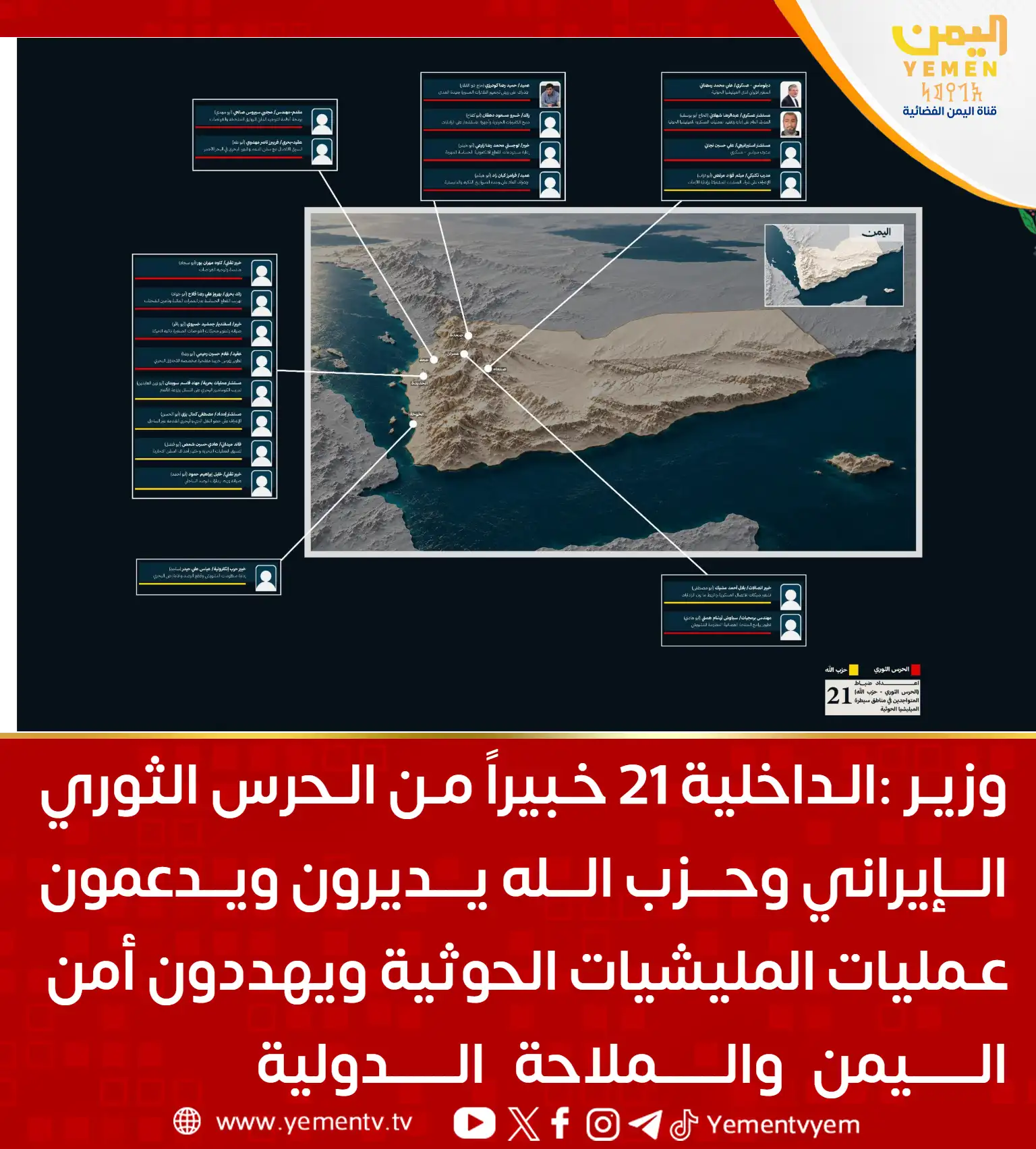
- Foreign Experts Supporting Houthi Militias Identified The Minister of Interior, Major General Ibrahim Haidan, confirmed the presence of 21 foreign experts working with the Iranian-backed Houthi terrorist militias.
- Specifically, there are 8 in Al Hudaydah, 4 in Sana'a, 4 in Saada, 2 in Hajjah, 2 in Amran, and 1 in Al Khawkhah.
- The Minister emphasized that this group does not represent a training mission but rather constitutes a complete general staff.
- This situation places the international community in a position to act against these interventions and practices.
Foreign Experts Supporting Houthi Militias Identified
The Minister of Interior, Major General Ibrahim Haidan, confirmed the presence of 21 foreign experts working with the Iranian-backed Houthi terrorist militias. This group includes 14 experts from the Iranian Revolutionary Guard and 7 from Hezbollah.
Nature of Their Involvement
In a statement released today by the Ministry of Interior, which the Yemeni News Agency (Saba) received, Major General Haidan explained that these experts’ roles reveal a significant escalation in foreign intervention. Their activities have shifted from funding, arming, and training to direct supervision, participation in planning, and managing operations. They also focus on building the military capabilities of the Houthi militia, alongside political, organizational, social, and media activities aimed at establishing long-term influence and creating loyalty networks to detach Yemen from its Arab surroundings.
Distribution of Experts Across Yemen
The Minister of Interior noted that these experts are distributed across six Yemeni governorates. Specifically, there are 8 in Al Hudaydah, 4 in Sana’a, 4 in Saada, 2 in Hajjah, 2 in Amran, and 1 in Al Khawkhah.
Areas of Expertise
The experts possess various specializations, including operations management, command and control, ballistic missiles, drone technology, surveillance systems, communication, electronic warfare, supply networks, and military component smuggling. They also coordinate maritime operations, select targets for commercial vessels, develop explosive-laden boats, engineer autonomous submarines, and train personnel in mine-laying and urban warfare tactics.
Leadership and Structure
Major General Haidan pointed out that the list of experts is led by a military figure from the Revolutionary Guard, who appears publicly as an ambassador for a country that claims to respect international law. The formation includes a general supervisor for operations, a strategic advisor, a director for the joint operations room, and officers of various ranks specializing in drone workshops and smart and ballistic missiles. Additionally, it comprises naval experts and specialists in radar, communications, and electronic warfare. The Minister emphasized that this group does not represent a training mission but rather constitutes a complete general staff.
Regional Security Threats
The Minister of Interior warned that these activities threaten regional security, the lives of sailors, and freedom of navigation in Bab al-Mandab and the Red Sea. They also jeopardize trade routes and energy supplies. Furthermore, he expressed concern about the transfer of military expertise and technology to other terrorist groups that share ideological ties with the militias. He stressed the importance of classifying the militias as a terrorist organization by the international community, dismantling their funding and arming networks, and enforcing the arms embargo established by UN Security Council Resolutions 2216 and 2624.
Houthi Control and External Influence
The Minister stated that the Houthi’s decision-making power is limited to the microphone, while actual decisions are made in Tehran and announced in Sana’a, with the people of Taiz, Al Hudaydah, and other affected governorates bearing the costs. He pointed out that the siege imposed by the Houthi militias on the city of Taiz exemplifies the consequences of the presence of Iranian Revolutionary Guard and Hezbollah experts, highlighting blatant foreign intervention and support for armed factions in the region. This situation places the international community in a position to act against these interventions and practices.
Impact on Yemeni Citizens
The Minister of Interior noted that Yemenis, especially those in areas under Houthi control, pay a heavy price for this intervention in terms of lives, security, and resources. He affirmed that this presence undermines regional and international security by supplying the Houthi terrorist militias with advanced weapons and technical expertise necessary for manufacturing and assembling components for ballistic missiles, drones, cruise missiles, and explosive-laden fast boats. This situation risks turning Yemen into a testing ground for weapon development and effectiveness.
Acknowledgment of Security Forces
The Minister praised the vigilance of security personnel and the efforts of security agencies in monitoring threats and tracking activities and networks associated with the militias. He commended their sacrifices and cooperation with armed forces and relevant agencies in protecting the internal front and enhancing the security and stability of citizens.
Ongoing Commitment to National Efforts
Minister Haidan confirmed that the Ministry of Interior will continue its duties and support national efforts within the “Dawn of Yemen” operation to restore state institutions and its capital, Sana’a, in defense of Yemen, its sovereignty, and the security of its citizens.
To follow the news in Arabic