The Chairman of the Leadership Council praises the multinational naval coalition and Saudi support for Yemen’s state institutions and regional stability.

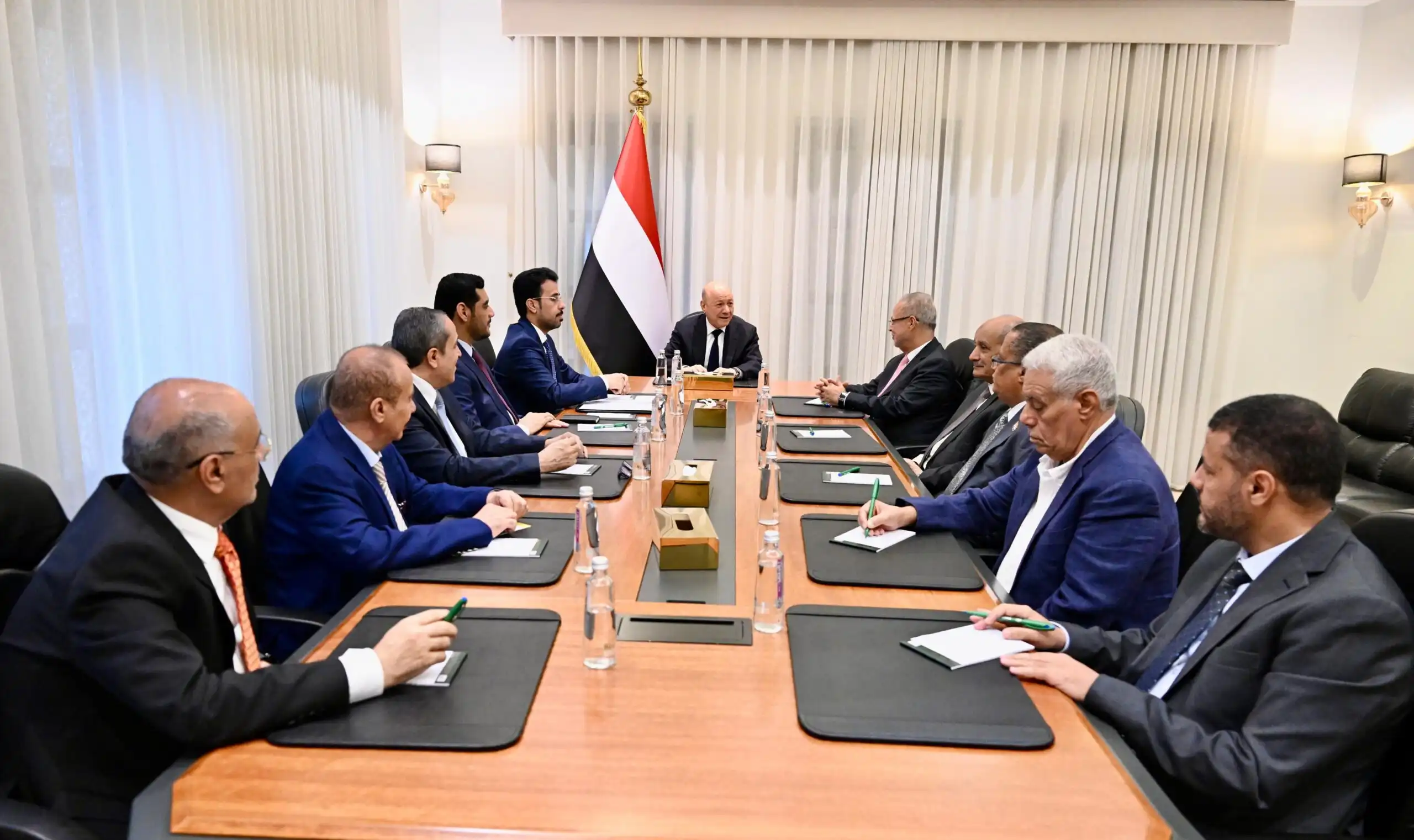
President Alimi Discusses Regional Developments and Houthi Threats
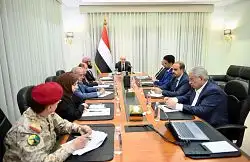
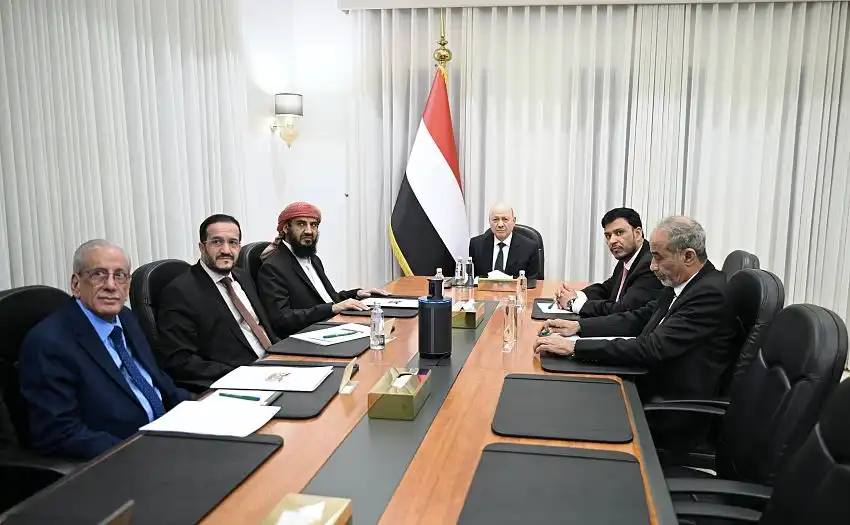
President Dr. Rashad Mohammed Alimi, head of the Presidential Leadership Council, convened a meeting with Mohammed Al-Ghaithi, head of the Consultation and Reconciliation Commission, and his deputies, Abdul Malik Al-Mikhlafi, Sakhr Al-Wajeeh, and Akram Al-Amri. The meeting also included secretaries-general of various political parties and members of the commission.
Addressing Local and Regional Challenges
The meeting focused on recent local developments and regional challenges, particularly the escalation of the Houthi militia, which is backed by the Iranian regime. President Alimi expressed concern over the militia’s reckless actions that jeopardize the interests and resources of the Yemeni people, exacerbating their humanitarian suffering.
Acknowledging the Role of the Consultation Commission
President Alimi reiterated his appreciation for the Consultation and Reconciliation Commission’s role as a vital supporter of the Presidential Leadership Council. He emphasized its importance in managing political diversity and safeguarding the partnership among national forces opposing the Houthi militia’s agenda.
The Need for Responsibility in a Critical Phase
The President highlighted the significance of this pivotal moment in Yemen’s history, calling for heightened responsibility. He noted that recent developments show the Houthi militia continues to escalate tensions for illegitimate gains, increasingly aligning its decisions with foreign agendas disconnected from Yemeni interests.
Government’s Firm Stance Against Houthi Aggression
During the meeting, President Alimi outlined the government’s proactive measures in response to Houthi provocations while maintaining national sovereignty. He asserted that the Yemeni government’s message remains clear and firm: it rejects coercion as a means to impose a new reality.
Saudi Arabia’s Support for Yemen
President Alimi praised the constructive role of Saudi Arabia, under the leadership of King Salman bin Abdulaziz and Crown Prince Mohammed bin Salman. He stated that Saudi Arabia’s positions have been crucial in maintaining the integrity of Yemeni state institutions, supporting the national economy, alleviating humanitarian suffering, and enhancing security and stability in Yemen and the region. This reflects the growing strategic partnership between the two nations.
Establishment of a Multinational Maritime Defense Coalition
The President also announced the creation of a multinational maritime defense coalition led by Saudi Arabia. He regarded this strategic initiative as vital for enhancing collective security, protecting international navigation, and securing critical maritime routes in the Red Sea, Gulf of Aden, and Bab el-Mandeb Strait.
A Call for Unity Among Yemeni Forces
President Alimi urged all Yemeni forces to capitalize on these changes, strengthen unity, and work collaboratively to solidify the internal front. He emphasized that the struggle for liberation is not solely the army’s battle but a collective effort for the republic.
Political Parties’ Role in National Awareness
The President stressed that political parties must reclaim their natural role as forces for enlightenment, mobilization, and advocacy against threats. He called for a renewed commitment to the concept of a national state and the isolation of the Houthi militia and its destructive agenda.
Engaging Society in State Restoration
President Alimi asserted that the current mission for political parties is to frame the restoration of state institutions as a societal issue, not just a matter of power. He expressed hope that the Consultation and Reconciliation Commission would evolve into a more effective national platform for fostering consensus and broad national alignment.
Increased Awareness Among Yemenis
Finally, President Alimi noted that Yemenis are now more aware than ever that their true battle lies against the project that has usurped the state, impoverished the people, and destroyed national resources, linking Yemen’s future to cross-border destructive agendas.
This meeting underscores the urgent need for unity and strategic action among Yemeni forces to confront ongoing challenges and work towards a stable and prosperous future for Yemen.
To follow the news in Arabic