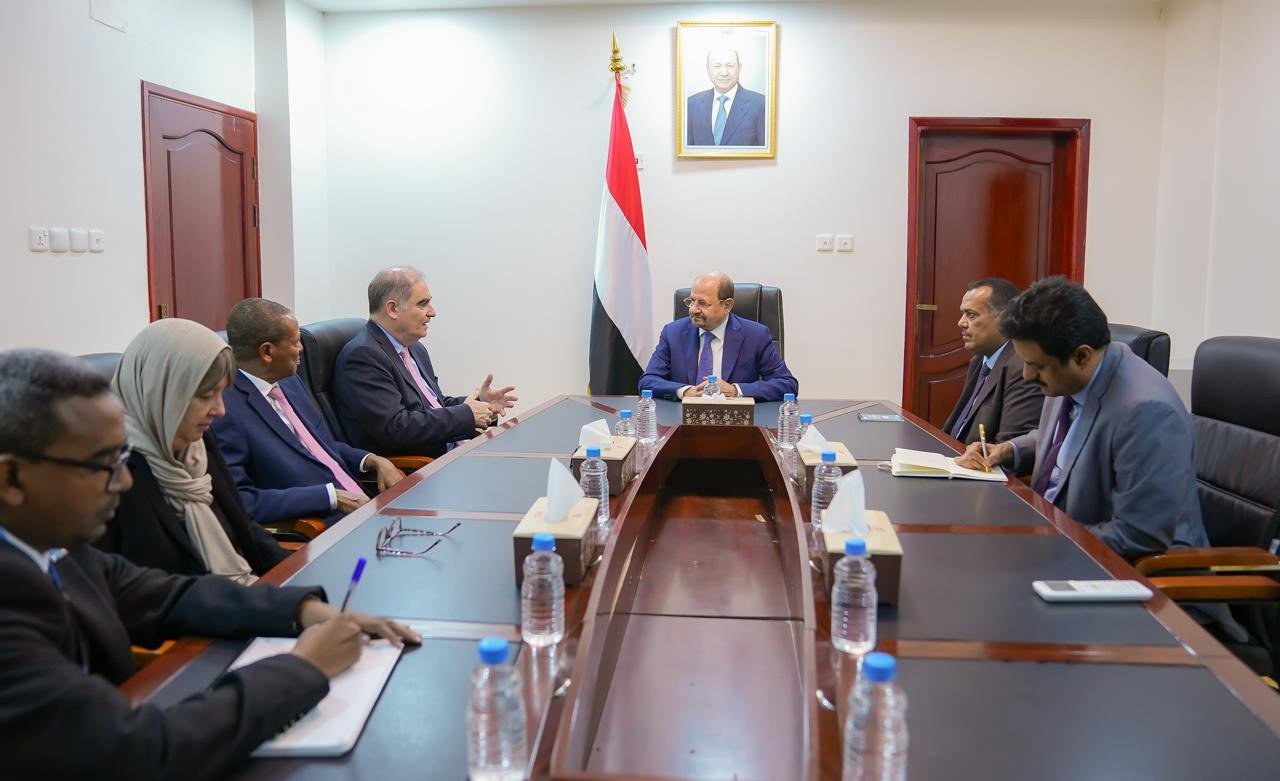
The Minister of State, Al-Ibari, discusses emergency response for displaced persons with a World Food Program delegation in Aden.

- Minister Walid Al-Ibara met with a WFP delegation to discuss displaced persons' needs.
- Humanitarian efforts by the WFP aim to alleviate displacement impacts from Houthi activities.
- Al-Ibara noted a significant gap between humanitarian needs and response capacities in affected areas.
- WFP confirmed readiness to assist up to 1.5 million beneficiaries, contingent on resources.
Minister Discusses Emergency Response for Displaced Persons in Yemen
On Sunday, Walid Al-Ibara, the Minister of State for Displacement and Irregular Migration, met with a delegation from the World Food Programme (WFP) in the temporary capital of Aden. The meeting, led by Damien Faker, the WFP’s Country Programme Director in Yemen, focused on enhancing cooperation and coordination between the two parties to address the urgent needs of displaced individuals.
Humanitarian Efforts Acknowledged
During the meeting, which also included Rashid Hamad, the WFP’s Field Director, Minister Al-Ibara praised the emergency humanitarian interventions implemented by the WFP. These efforts aim to alleviate the impact of displacement caused by the recent escalation of Houthi terrorist activities in the rural areas of Taiz Governorate, its southern districts, and the western coast. The minister also highlighted the WFP’s readiness to respond to humanitarian emergencies in host governorates, particularly in Aden, Taiz, Lahij, and Abyan.
Current Humanitarian Situation
Al-Ibara reviewed the latest developments in the humanitarian crisis and the needs of displaced persons in affected governorates. He pointed out a significant gap between the scale of humanitarian needs and the level of available response.
Escalation in Taiz Raises Concerns
The minister emphasized that the ongoing escalation in Taiz could worsen the humanitarian situation. He noted that current displacement indicators signal a more challenging phase ahead, especially given the determination of Houthi militias and Iranian forces to escalate the conflict in Yemen and the region.
Government’s Commitment to Humanitarian Response
Al-Ibara underscored the Yemeni government’s commitment to enhancing its involvement in humanitarian response efforts. He stated that the government is working collaboratively with humanitarian partners to address the crisis’s repercussions. Furthermore, he mentioned that the government is preparing a displacement plan to organize and coordinate humanitarian interventions and facilitate aid delivery to those in need.
WFP’s Capacity to Respond
In response, the international official commended the government’s efforts and serious intentions to strengthen humanitarian response. Faker confirmed that the WFP possesses extensive capabilities to quickly reach areas in need. He expressed readiness to expand its intervention to cover up to one and a half million beneficiaries, depending on available resources and needs.
Ongoing Verification of Displaced Persons
Faker explained that the WFP has verified data for approximately 113,000 displaced individuals out of 157,000 affected by the recent escalation. He assured that the WFP would continue to monitor humanitarian needs and respond according to priorities.
Phased Humanitarian Response
He added that the humanitarian response occurs in two phases: the first phase involves emergency response within 72 hours, while the second phase extends over three months. This includes providing initial support, and in areas with nearby markets, cash assistance is offered. The WFP currently serves around one million seven hundred thousand displaced individuals in Yemen.
To follow the news in Arabic