The Minister of Industry and Trade chaired a meeting of the National Committee for Trade Facilitation in Aden.

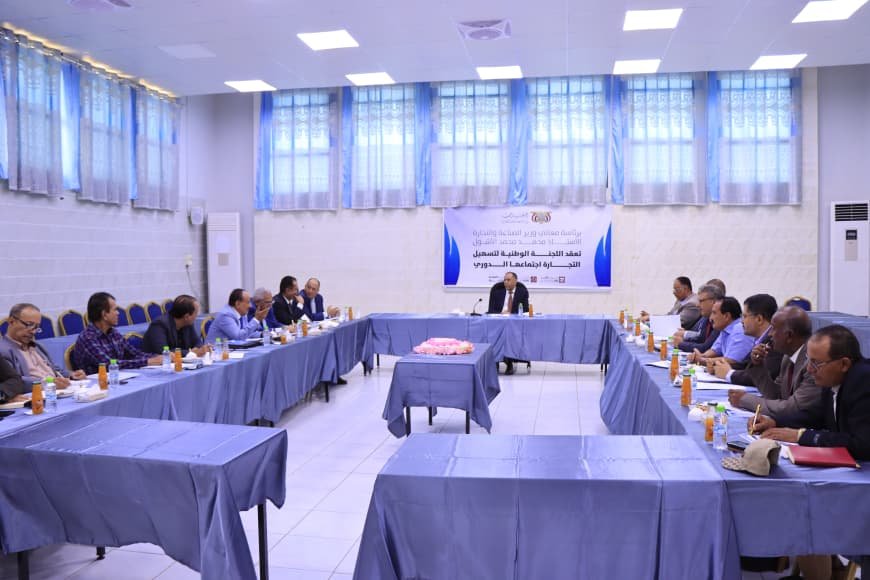
- Dr. Mohammed Al-Ashwal chaired a meeting of the National Trade Facilitation Committee in Aden.
- The meeting focused on the National Trade Facilitation Strategy for 2025-2035.
- Minister Al-Ashwal highlighted trade stability as a national and humanitarian priority amid challenges.
- Regional and international partners were urged to provide ongoing technical support for trade development.
Minister of Industry and Trade Leads National Trade Facilitation Committee Meeting in Aden
Dr. Mohammed Al-Ashwal, the Minister of Industry and Trade and head of the National Trade Facilitation Committee, chaired a meeting today in the temporary capital of Aden. The meeting focused on the committee’s activities amid current developments and discussed the National Trade Facilitation Strategy and the roadmap for the period 2025-2035. The goal of this strategy is to enhance the trading environment and improve the flow of goods and services.
Committee’s Role and Responsibilities
During the meeting, participants reviewed the committee’s role, responsibilities, and organizational procedures. They also addressed the challenges facing trade movements due to ongoing regional developments. The discussion included the objectives of the National Strategy for implementing trade facilitation reforms over the next decade and the ministry’s participation in World Trade Organization meetings.
Trade Challenges in Yemen
Minister Al-Ashwal emphasized that the meeting occurs under exceptional circumstances in Yemen, where security, military, economic, and humanitarian challenges intertwine. He stressed the need for enhanced coordination, increased readiness, and rapid response among various stakeholders. He pointed out that the escalation by the Houthi terrorist militias and their targeting of vital maritime routes along the western coast and Bab al-Mandab poses a direct threat to supply chains and the flow of essential goods. Therefore, maintaining trade stability and securing basic needs remains a national and humanitarian priority.
National Trade Facilitation Strategy
The Minister explained that the National Trade Facilitation Strategy and the roadmap for 2025-2035 provide a practical framework for addressing existing challenges. This includes simplifying procedures and enhancing institutional integration through legal, regulatory, and procedural reforms. The strategy also emphasizes expanding digital transformation, developing information and communication technology infrastructure, and building capacities. The ministry remains committed to supporting the implementation of the committee’s outcomes and monitoring progress in coordination with relevant entities.
Regional and International Support
The Minister called on regional and international partners to continue providing technical support in the upcoming phase. This support will contribute to developing digital infrastructure, enhancing the capabilities of trade outlets, and exchanging expertise in risk management, single-window operations, and digitization.
Presentation on Customs and Ports
During the meeting, Abdul Hakim Al-Qabati, head of the Customs Authority, presented an overview of the role of customs in enhancing supply chains during the period 2025-2026. He discussed the challenges facing the customs sector amid the current economic conditions and the measures taken to ensure the continuous flow of goods and facilitate trade.
Additionally, Ali Al-Sabhi, Deputy Minister of Transport, provided a report on the status of ports and maritime traffic in light of the Houthi terrorist militias’ attacks and their implications for maritime security from August to September 2026. This report covered the southern Red Sea, Bab al-Mandab, Gulf of Aden, Strait of Hormuz, and the Arabian Gulf.
Furthermore, Mohammed Al-Humaidi, Deputy Minister of Industry and Trade for Foreign Trade, highlighted the key aspects of the National Trade Facilitation Strategy and the roadmap for 2025-2035. He outlined the reforms aimed at simplifying and unifying procedures, reducing time and costs, enhancing transparency and coordination among relevant entities, and expanding digitization and automation through a single-window system.
To follow the news in Arabic