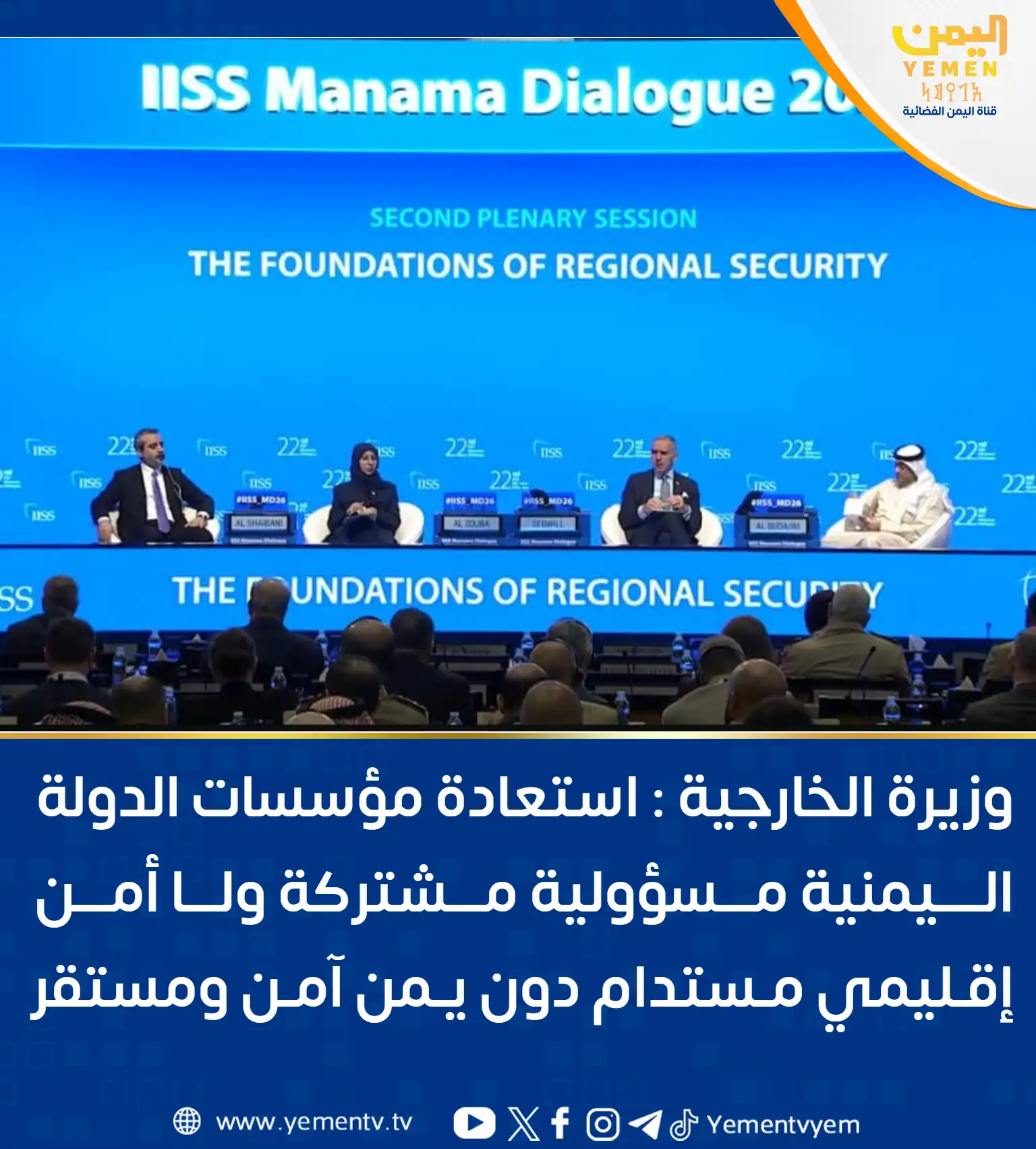
Foreign Minister: Restoring Yemen’s state institutions is a shared responsibility; no sustainable regional security without a stable Yemen.

- Yemeni Foreign Minister Emphasizes Shared Responsibility for State Restoration Dr.
- Foundations for Sustainable Regional Security Al-Zuba outlined four foundations for building sustainable regional security.
- Maritime Security Linked to Yemen's Stability Al-Zuba confirmed that the security of navigation in the Red Sea and Bab al-Mandab is inseparable from Yemen's stability.
- Protection of Civilians as a Security Pillar The minister stated that protecting civilians and cities represents a fundamental pillar for regional security.
Yemeni Foreign Minister Emphasizes Shared Responsibility for State Restoration
Dr. Afrah Al-Zuba, the Yemeni Minister of Foreign Affairs and Expatriates, affirmed that supporting the restoration of Yemeni state institutions and enhancing their capabilities represents a shared responsibility. She highlighted that this effort serves as a fundamental pillar for achieving regional security and protecting international navigation. Al-Zuba stressed that discussions about sustainable regional security cannot occur without a secure and stable Yemen.
Impact of the Yemeni Crisis on Regional Security
During her speech at the third plenary session of the Manama Dialogue 2026, titled “Foundations of Regional Security,” the minister noted that the repercussions of the coup against the Yemeni state have extended beyond Yemen’s borders, affecting the security of neighboring countries, maritime navigation, and international interests. She called for translating solidarity into practical steps that address the sources of threats and establish sustainable stability.
Foundations for Sustainable Regional Security
Al-Zuba outlined four foundations for building sustainable regional security. These include respecting state sovereignty and enhancing the effectiveness of national institutions, prioritizing diplomacy and dialogue, adopting a comprehensive security concept that encompasses economic stability, energy and food security, civilian protection, safeguarding vital facilities, combating terrorism and smuggling, and protecting maritime routes and international trade lines.
Importance of Preventive Diplomacy
She emphasized the importance of preventive diplomacy and regional mechanisms based on non-interference and good neighborliness. Al-Zuba asserted that any path concerning Yemen must be led by the Yemeni state to preserve its sovereignty and restore its institutions while ensuring that weapons remain under state control.
External Interventions Undermine Stability
The foreign minister explained that external interventions and support for armed groups contesting state authority undermine stability opportunities. She referenced a report from the UN Expert Group indicating that the Houthi militia receives weapons, technical assistance, training, and financial support from Iran and other armed groups.
Maritime Security Linked to Yemen’s Stability
Al-Zuba confirmed that the security of navigation in the Red Sea and Bab al-Mandab is inseparable from Yemen’s stability. Protecting maritime routes requires addressing sources of threats, halting the flow of weapons, funding, and expertise, combating smuggling networks, and enhancing the capabilities of coastal states.
Concerns Over Armed Groups and Organized Crime
She warned about the growing links between armed groups and organized crime networks, urging for enhanced information sharing, drying up funding sources, and monitoring the transfer routes of weapons and expertise across borders.
Call to Lift the Siege on Taiz
Al-Zuba described the Houthi militia’s siege of the city of Taiz as a war crime. She called for the immediate lifting of the siege and the permanent and safe opening of roads. Additionally, she urged the United Nations to support an urgent investigation into field reports regarding the use of shells suspected of containing toxic materials.
Protection of Civilians as a Security Pillar
The minister stated that protecting civilians and cities represents a fundamental pillar for regional security. She pointed out that the repeated targeting of Aden Airport threatens civil aviation safety and the delivery of humanitarian aid.
Ending the Coup as a Path to Stability
Al-Zuba reiterated that addressing sources of threats begins with ending the coup, restoring state institutions, and asserting authority over the entire national territory according to the three references. She emphasized the necessity of confining weapons and decisions of war and peace to the state.
Commitment to Restoring the Yemeni State
In conclusion, she affirmed that the Yemeni government is committed to the battle of state restoration and looks forward to the support of its partners to enhance the capabilities of its institutions, enforce the arms embargo, and halt the flow of weapons to militias. Al-Zuba stressed that a stable Yemen will return as an active partner in safeguarding regional security and protecting maritime and international trade.
To follow the news in Arabic