A regional workshop concluded in Kuwait to adopt an Arab framework for the governance of educational evaluation institutions.

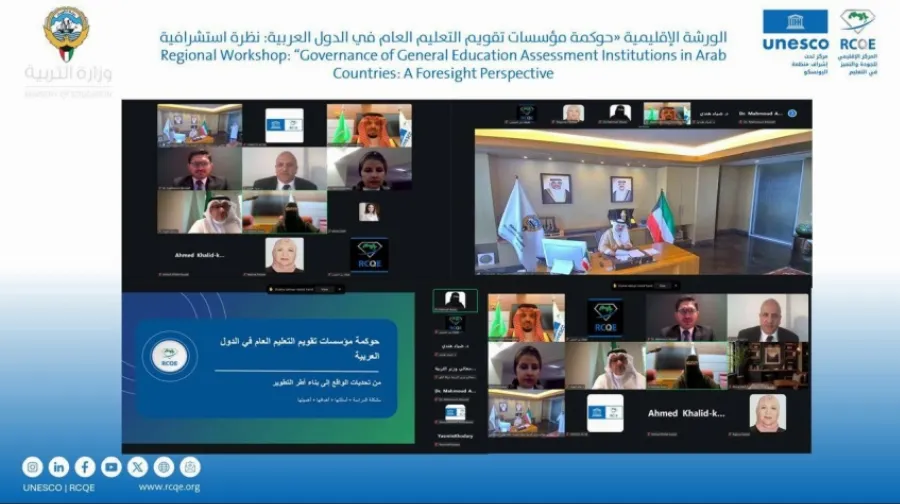
- The workshop on educational evaluation governance concluded in Kuwait.
- Kuwaiti Minister emphasized governance as essential for educational reform and decision-making.
- A common Arab governance framework aims to enhance education quality and equity.
- The workshop proposed a reference framework based on five key governance dimensions.
Regional Workshop on Education Evaluation Governance Concludes in Kuwait
The Regional Center for Quality and Excellence in Education, in collaboration with the Kuwaiti Ministry of Education, concluded its regional workshop titled “Governance of General Education Evaluation Institutions in Arab Countries: A Forward-Looking Perspective.” The event took place under the patronage and presence of the Kuwaiti Minister of Education, Engineer Said Jalal Al-Tabatabai, and included participation from educational leaders, experts, researchers, and representatives from regional and international organizations.
Importance of Governance in Education
In his opening speech, the Kuwaiti Minister of Education emphasized that the governance of evaluation institutions serves as a fundamental pillar for educational reform and evidence-based decision-making. He highlighted Kuwait’s efforts in developing measurement and evaluation systems and digital transformation through more than thirty electronic platforms and systems aimed at supporting transparency, performance efficiency, and educational decisions.
Transforming Evaluation Results into Sustainable Policies
Dr. Abdulrahman Al-Mudayris, the Director-General of the Regional Center for Quality and Excellence in Education, stated that the true value of evaluation lies in transforming its results into decisions, policies, and sustainable improvements. He pointed out the necessity of developing a common Arab governance framework that considers national context differences while enhancing education quality and equity.
Focus on Institutional Governance
Dr. Fatima Al-Ruwais, the Assistant Director-General of the center, presented the study’s objectives and its scientific and developmental significance. She stressed the need to shift focus from measurement tools to enhancing the governance of institutions responsible for evaluation and their capacity to translate evidence into sustainable educational impact.
International Practices and Future Scenarios
The workshop featured scientific presentations that addressed international practices, the Arab reality, and the future of governance in the age of artificial intelligence. It also showcased Kuwait’s experience in developing institutional structures, evaluating students and teachers, curriculum assessment, and enhancing community participation. A curriculum evaluation survey recorded participation from one hundred ninety-four thousand five hundred forty-two individuals, with parents constituting sixty-one point nine percent of the participants.
Proposed Reference Framework for Governance
The workshop discussed the proposed standard reference framework for the governance of education evaluation institutions, based on five dimensions: vision and strategic thinking, transparency, participation, effectiveness and capacity building, and responsiveness and equity. It also reviewed future scenarios for institutional development.
Final Recommendations and Framework Approval
The workshop concluded with the adoption of the standard reference framework for the project and the issuance of a final statement that included recommendations to enhance the independence and capabilities of evaluation institutions, develop a common Arab framework, establish a regional observatory and periodic governance maturity index, and create shared Arab tools and capacity-building programs led by the center.
The center confirmed that the outcomes of the workshop contribute to strengthening Arab cooperation to develop more efficient and transparent evaluation institutions that respond to future needs, supporting the achievement of the fourth Sustainable Development Goal related to quality and equitable education for all.
To follow the news in Arabic