The Foreign Minister stated that the security of the Red Sea is a shared strategic interest for Yemen and Egypt.

- Yemen and Egypt share a strategic interest in Red Sea security.
- Minister Al-Zouba emphasizes strengthening historical ties and bilateral cooperation.
- High-level discussions aim to enhance the Yemeni-Egyptian partnership amid regional challenges.
- Egypt supports Yemen's sovereignty and the restoration of its national institutions.
Red Sea Security: A Strategic Interest for Yemen and Egypt
Minister Affirms Shared Interests
Dr. Afrah Al-Zouba, Yemen’s Minister of Foreign Affairs and Expatriates, emphasized that the security of the Red Sea represents a strategic interest shared by both Yemen and Egypt. She noted that the Bab el-Mandeb Strait and the Suez Canal form interconnected links within a single maritime corridor. Consequently, the stability of the southern Red Sea is crucial for the security of regional and international navigation and trade.
Strengthening Historical Ties
Minister Al-Zouba highlighted the deep historical and fraternal relations between Yemen and Egypt. She expressed a commitment to building upon these ties and expanding areas of cooperation and coordination to serve the interests of both nations and their peoples. The minister stressed the importance of activating frameworks for bilateral cooperation, organizing joint committee meetings, and expediting the formation of a Yemeni-Egyptian Business Council. These efforts aim to enhance trade, investment, and economic exchange.
High-Level Discussion on Strategic Partnership
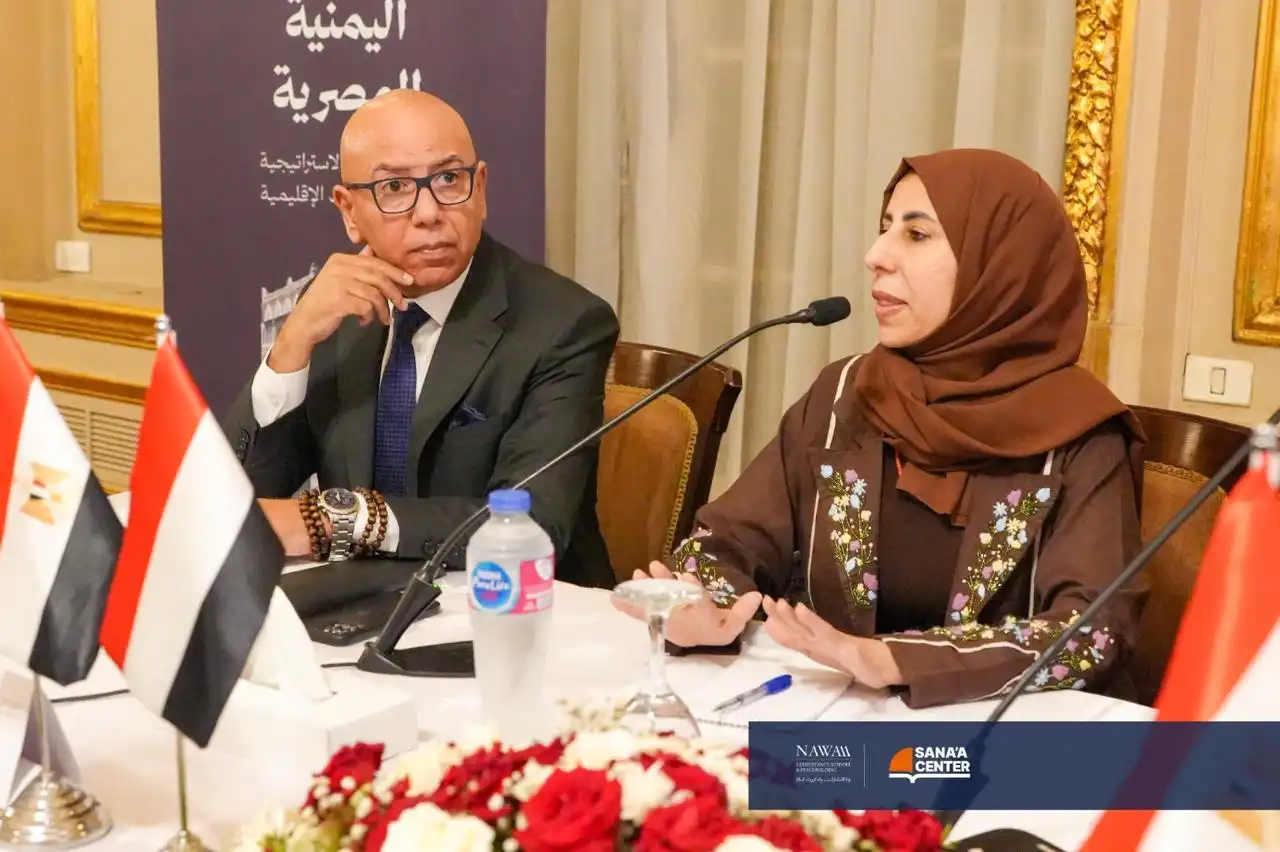
During a high-level discussion in Cairo, organized by the Nawa Foundation for Consulting, Support, and Peacebuilding in collaboration with the Sana’a Center for Strategic Studies, Minister Al-Zouba addressed ways to strengthen the Yemeni-Egyptian partnership amid ongoing regional challenges. The event featured a distinguished group of experts and diplomats from both countries, focusing on developing relations and advancing cooperation to serve mutual interests.
Support for Yemen’s Sovereignty
Al-Zouba discussed her talks with Dr. Badr Abdel-Aty, Egypt’s Minister of Foreign Affairs and International Cooperation. These discussions reflected Egypt’s steadfast support for Yemen’s national state and its institutions, emphasizing the importance of maintaining Yemen’s unity, sovereignty, and territorial integrity. This support enhances the ability of Yemeni institutions to fulfill their responsibilities, restore security and stability, and safeguard the resources of the Yemeni people. The minister underscored the need for enhanced coordination between the two countries to address regional challenges and their implications for the security of the Red Sea and Bab el-Mandeb, as well as the economic repercussions for neighboring countries, particularly Egypt, and international trade.
Ongoing Crisis in Yemen
The Foreign Minister pointed out that Yemen has endured the repercussions of the Houthi coup against state institutions and political consensus for twelve years. This situation has adversely affected the lives and resources of Yemenis and extended to regional security and international maritime routes. Al-Zouba asserted that the Houthis have exploited periods of calm to bolster their military capabilities and expand their attacks on government-controlled areas and maritime routes.
Call for International Support
Al-Zouba stated that developments in Yemen have transcended internal matters, impacting regional security and international maritime routes. She emphasized the necessity of supporting the Yemeni government to restore state institutions and assert sovereignty over its territory. This support will enable the government to fulfill its responsibilities and restore security and stability.
Challenges in Peace Negotiations
The Yemeni government has engaged in numerous dialogue and understanding efforts over the years to resolve the crisis. However, these efforts have not yielded the desired results. Al-Zouba noted the Houthis’ failure to adhere to agreements reached during various phases, highlighting that peace efforts relied on key references, including the Gulf Initiative, the outcomes of the National Dialogue Conference, and relevant UN Security Council resolutions. Unfortunately, the lack of commitment to these references has hindered the achievement of a sustainable political settlement.
Difficulties in Reaching an Agreement
Dr. Al-Zouba remarked, “Previous experiences have shown the difficulty of reaching an actionable understanding with the Houthis, despite multiple rounds of dialogue and diplomatic efforts.” She affirmed that the legitimate government has consistently sought to provide the political track with opportunities to resolve the crisis. She added, “One aspect of the problem lies in the Houthis’ perception of other components of Yemeni society.” They view themselves as a superior class, which affects their understanding of partnership and citizenship. Al-Zouba stressed that Yemen’s stability requires a state that upholds equality among all its citizens without discrimination.
Commitment to Political Solutions
The minister reaffirmed the government’s commitment to a political solution. She insisted that any ceasefire should serve as a pathway to a political resolution rather than a cover for entrenching the status quo and prolonging the crisis. Restoring state institutions and ending the coup are fundamental to achieving security and stability. Any viable settlement must lead to a unified state, national institutions, and weapons governed by the constitution and law. Al-Zouba noted that the door for disarmament and engagement in state institutions remains open within a framework of law, justice, and equal citizenship for all Yemenis.
International Response Needed
Al-Zouba pointed out that the international response to recent developments remains inadequate given the implications of attacks on civilians and vital facilities. She stressed the need for a clearer international stance to support de-escalation efforts and create conditions conducive to resuming the political process. Additionally, she highlighted the importance of supporting Yemen’s transition from emergency response to sustainable recovery, development, and reconstruction, directing resources toward essential services and infrastructure to bolster the national economy.
Misuse of the Palestinian Cause
The minister noted that the Houthis attempt to portray themselves as champions of the Palestinian cause to garner popular support. She criticized their use of the Palestinian issue as a pretext to cling to power and serve Iranian agendas in the region. Al-Zouba affirmed that the Palestinian cause does not belong to any single Yemeni faction, as the Yemeni people, in all their components, value this issue and support the rights of the Palestinian people.
Commitment to Palestinian Rights
Al-Zouba emphasized that the legitimate government is among the most committed parties to the Palestinian cause, rejecting any attempts to exploit it for political gain. She reiterated Yemen’s unwavering support for the rights of the Palestinian people and their quest for an independent state with sovereignty along the borders of June 4, 1967, with East Jerusalem as its capital, in accordance with international resolutions and the Arab Peace Initiative.
Conclusion: A Call for Unity and Justice
In conclusion, the Foreign Minister reiterated, “The door for disarmament and engagement in state institutions remains open within a framework of law, justice, and equal citizenship for all Yemenis without discrimination.”
For more information, visit Yemen TV.
To follow the news in Arabic