Yemen calls on the Iranian regime to stop arming militias and cease trading in the blood of Yemenis.

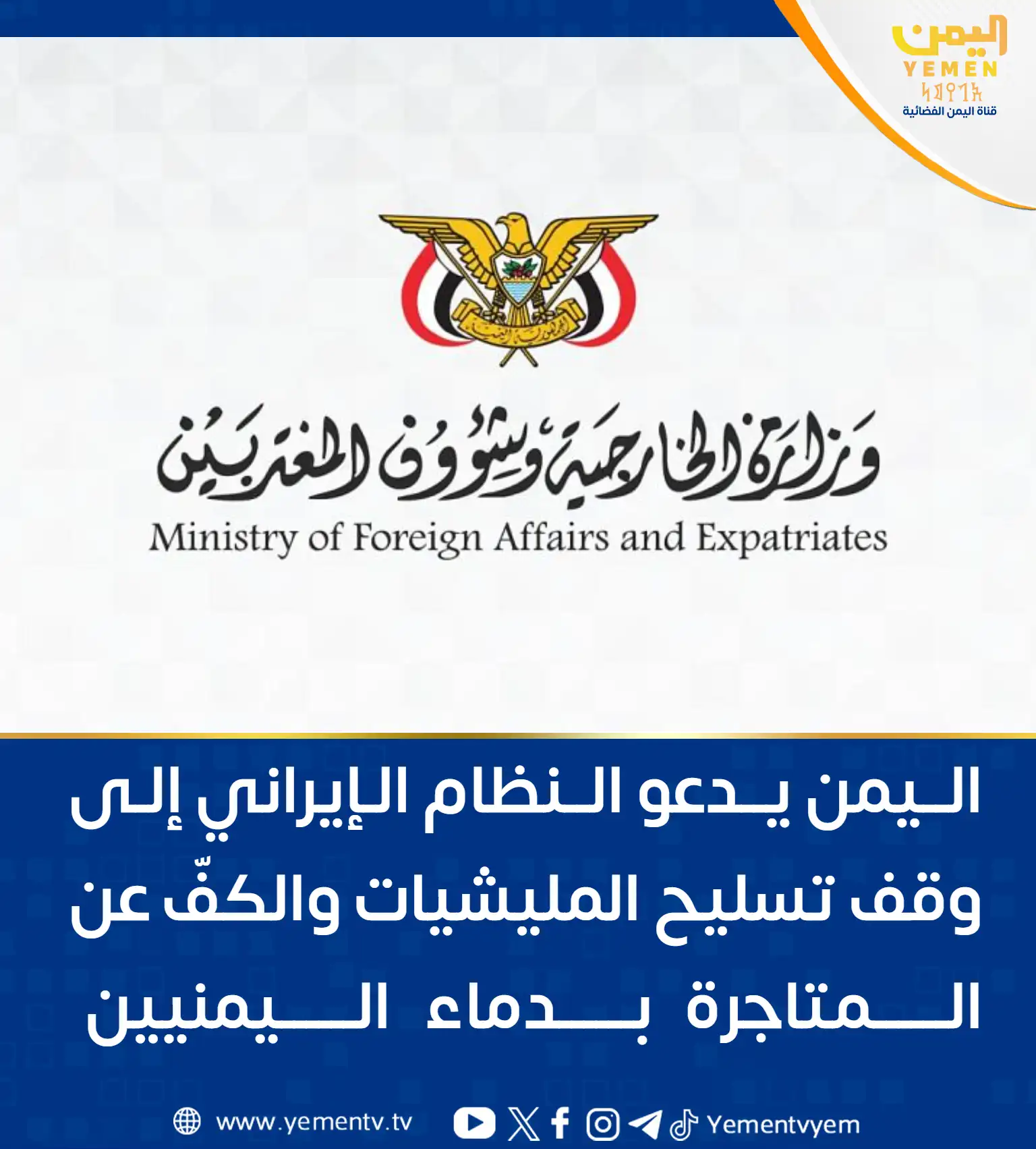
- Yemen Condemns Iranian Foreign Ministry's Statement The Yemeni Ministry of Foreign Affairs and Expatriates has strongly condemned the recent statement issued by the Iranian Foreign Ministry regarding Yemen.
- Concurrently, Yemeni authorities have disclosed that Iranian intervention has shifted from financing, arming, and training to direct involvement in planning and managing operations.
- Military Operations and Coordination These experts are involved in leadership, control, and operational management, working in areas such as ballistic missiles, drone warfare, electronic warfare, and military component smuggling.
- Additionally, there are repeated assaults on Saudi territory, shipping vessels, and navigation in the Red Sea and Bab al-Mandab.
Yemen Condemns Iranian Foreign Ministry’s Statement
The Yemeni Ministry of Foreign Affairs and Expatriates has strongly condemned the recent statement issued by the Iranian Foreign Ministry regarding Yemen. The ministry described the statement as containing misleading claims and as a blatant interference in the internal affairs of the Republic of Yemen. This interference aims to provide political and media cover for the Houthi terrorist militias while absolving the Iranian regime of responsibility for prolonging the war and deepening the humanitarian tragedy faced by the Yemeni people.
Iran’s Support for Houthi Militias
The ministry emphasized that the Iranian statement reveals Tehran’s open endorsement of the narrative promoted by the coup militias. It also justifies the actions of these militias. Concurrently, Yemeni authorities have disclosed that Iranian intervention has shifted from financing, arming, and training to direct involvement in planning and managing operations.
In its statement, the ministry noted, “This correlation between military support and diplomatic cover serves as additional evidence of the Iranian role in undermining the Yemeni state and threatening regional security and maritime routes.”
Exploitation of Victims’ Blood
The ministry rejected the Iranian regime’s exploitation of the victims of the Al-Hudayda market crime in the Al-Wazi’iyah district of Taiz Governorate, as well as other areas, to promote accusations that contradict the statements of Yemeni authorities. This includes calls for independent investigations into the Houthi militias’ violations of human rights and international law.
The Ministry of Foreign Affairs reminded the public of the Interior Ministry’s announcement regarding the presence of 21 foreign experts working with the Houthi militias. This group includes 14 experts from the Iranian Revolutionary Guard and seven from Hezbollah.
Military Operations and Coordination
These experts are involved in leadership, control, and operational management, working in areas such as ballistic missiles, drone warfare, electronic warfare, and military component smuggling. They also coordinate maritime operations and select targeted commercial vessels, forming a comprehensive command structure that extends beyond training to supervision and management of operations. Yemenis pay the price for these actions with their lives, security, and resources.
Iranian Arms and Regional Security
The Ministry of Foreign Affairs asserted that by arming the Houthi militias and supplying them with experts, Iran enables them to continue their acts of terror in Yemen. This includes kidnapping, killing, and terrorizing civilians, as well as bombing cities and civilian facilities, besieging populations, and starving them. Additionally, there are repeated assaults on Saudi territory, shipping vessels, and navigation in the Red Sea and Bab al-Mandab.
The ministry stated, “This intervention embodies a pattern that the Iranian regime has consistently followed in undermining the security of regional countries by financing rogue groups that challenge the exclusive authority of national governments over the use of force and decisions of war and peace.”
Call for Respecting Sovereignty
The ministry added that the arms embargo imposed under Resolution 2216, which was expanded under Resolution 2624 to include the Houthis as an entity, encompasses weapons, equipment, technical assistance, training, and funding related to military activities.
The Ministry of Foreign Affairs emphasized that Iran’s interests, security, and future relations in the region require respect for the sovereignty of states. It called for building good neighborly relations based on mutual interests, non-interference in internal affairs, and abandoning the policy of arming its affiliated destructive groups.
The ministry stressed that the Iranian regime should redirect its resources and wealth to improve the living conditions of the Iranian people and meet their needs for development, services, and job opportunities, rather than wasting them on arms networks, smuggling, and destabilizing the region.
Humanitarian Assistance from Saudi Arabia
The ministry pointed out that the Iranian regime has provided the Yemeni people with nothing but rockets, suicide drones, and explosive-laden boats, along with experts of destruction, throughout the twelve years of war ignited by the Houthi militias with its support. In contrast, the Kingdom of Saudi Arabia has offered invaluable humanitarian and developmental assistance, along with countless facilities for Yemeni expatriates, whose work and remittances support millions of people.
The Ministry of Foreign Affairs concluded that respecting Yemen’s sovereignty begins with halting the arming of militias, withdrawing experts, and refraining from interfering in Yemen’s national decision-making. It asserted that Tehran’s alleged concern for the lives of Yemenis also requires ceasing the use of tools that prolong suffering and exacerbate destruction.
To follow the news in Arabic